Steven Holl, at 63, is widely considered one of the most original talents of his era. His work has influenced a generation of architects and students. And over the last decade or so he has become a star in faraway places like Scandinavia and China, where he is celebrated as someone able to imbue even the most colossal urban projects with lyricism. Yet his career at home has been negligible. He has had only a handful of notable commissions in the United States, and his output in New York is embarrassingly modest. So when the Queens Library Board of Trustees approved the design of the new Hunters Point community library this month, it was a well-deserved and long overdue breakthrough. The project will stand on a prominent waterfront site just across the East River from the United Nations. The building’s beguiling appearance — with giant free-form windows carved out of an 80-foot-tall rectangular facade of rough aluminum — should make it an instantly recognizable landmark. Seen from Manhattan, it will have a haunting presence on the waterfront and at dusk the library’s odd-shaped windows will emit an eerie glow. Only at the site itself, however, will the optimism driving Mr. Holl’s design come into focus. The library will stand at the western edge of Queens West and Mr. Holl’s design is not about escaping this world but transforming it into something more poetic. Approaching from the towers across the street, visitors will enter a tranquil reading garden. As visitors move closer to the library, they will be able to see through the lobby windows and out over a reflecting pool and the riverfront park. Other odd-shaped windows will allow diagonal glimpses up through the building and out to the sky. This facade brings to mind Gordon Matta-Clark’s 1975 “Day’s End,” in which Matta-Clark used a power saw to carve big circular openings into the exterior of an abandoned industrial building on the Hudson River in Lower Manhattan. In both works the over scaled cut-out openings are powerfully metaphorical. They suggest the desire to expose private, interior worlds to public scrutiny, and — by seeming to undermine the buildings’ structural stability — they evoke an unstable, ever-changing world. But Mr. Holl’s design is also a statement about the individual’s place in a larger communal framework. The lobby is a towering space framed on both sides by several big, balcony like reading rooms. To get to them visitors climb a staircase that runs up the lobby’s back wall and past one of the huge free-form windows that afford views of the East River and Manhattan. But it is the constant reminders of the larger world provided by the giant cuts through the building’s surface that give the design so much resonance. Mr. Holl is not interested in creating a monastic sanctuary; he wants to build a monument to civic engagement. The views aren’t just pretty; they remind us that the intellectual exchange of a library is part of a bigger collective enterprise. It’s a lovely idea, and touching in its old-fashioned optimism.
Excerpted from:
NICOLAI OUROUSSOFF
New York Times
Monday, January 31, 2011
Friday, January 28, 2011
HAMMER MUSEUM: All of This And Nothing
January 30 - April 24, 2011
All of this and nothing is the sixth in the Hammer Museum’s biennial invitational exhibition series, which highlights work of Los Angeles-based artists, both established and emerging, alongside a number of international artists. All of this and nothing features more than 60 works, much of it created for the exhibition, by fourteen artists: Karla Black, Charles Gaines, Evan Holloway, Sergej Jensen, Ian Kiaer, Jorge Macchi, Dianna Molzan, Fernando Ortega, Eileen Quinlan, Gedi Sibony, Paul Sietsema, Frances Stark, Mateo Tannatt and Kerry Tribe. The first major exhibition at the Hammer to be curated jointly by the museum’s chief curator, Douglas Fogle and senior curator Anne Ellegood, this exhibition presents a wide range of media including painting, sculpture, drawing, installation, sound, performance, and the moving image. The artists explore fundamental questions about our experiences of existing in the world and in the potential for art to reveal the mysterious and the magical. Reaching beyond exclusively visual references, many works incorporate aspects of music, literature, science, mathematics, sound, or time into their subject matter or structure. This group of intergenerational artists closely considers the process of art-making in their work by playing with scale, the ephemeral quality of their materials, the nature of time and language, and the relationships between the objects that they create. Their work explores ideas of disappearance and reemergence, of shifting visibilities, as well as the beauty found in the everyday. These artists resist notions of autonomy and completeness in favor of openness to multiple interpretations over time. For them the value of the work resides more in the process of its making than in the resulting objects.
Monday, January 24, 2011
MACRO MUSEUM IN ROME
Plus Ultra
Works from The Sandretto Re Rebaudengo Collection
Until 20 March 2011
Piotr UKLANSKI, "Untitled (Monster)," 2009.
Juta, linen, plant fiber, aluminium.
MACRO and Fondazione Sandretto Re Rebaudengo are proud to present PLUS ULTRA, a selection of major works from the Sandretto Re Rebaudengo Collection, curated by Francesco Bonami, at MACRO Testaccio, Rome until 20 March 2011. This is the first time a group exhibition featuring works from Patrizia Sandretto Re Rebaudengo's contemporary art collection, first started in the early nineties, has been shown in Rome, presenting an important selection of highly acclaimed Italian and International contemporary artists. PLUS ULTRA, which takes its name from a work featured in the exhibition by Polish artist Goshka Macuka (previewed at the 2009 edition of the Venice Biennale) presents the work of thirty-eight artists utilizing painting, sculpture, video, photography and installation, offering an in depth insight into today's art. Among the artists featured in the show are: John Bock, Damien Hirst, Pawel Althamer, Carsten Höller, Sarah Lucas, Tobias Rehberger, Piotr Uklanski, Cerith Wyn Evans, Maurizio Cattelan, Giuseppe Gabellone, Diego Perrone, Paola Pivi and Patrick Tuttofuoco.
Friday, January 21, 2011
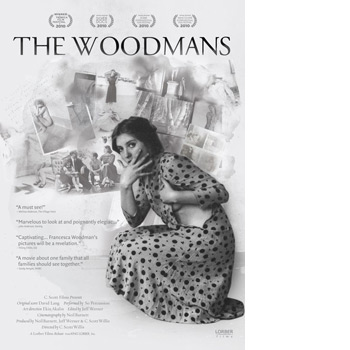
THE WOODSMANS: Provocative Portrait of Photographer Francesca Woodman and Her Artist Family
Documentary Had U.S. Theatrical Premiere Wednesday, January 19 at Film Forum
Francesca Woodman's haunting B&W images, many of them nude self-portraits, now reside in the pantheon of great photography from the late 20th century. The daughter of artists Betty and Charles Woodman (she a ceramicist and he a painter/ photographer), Francesca was a precocious RISD graduate, who came to New York with the intention of setting the art world on fire. But in 1981, as a despondent 22-year-old, she committed suicide.
THE WOODMANS beautifully interweaves the young artist's work (including experimental videos and diary passages) with interviews with the parents who have nurtured her professional reputation these past 30 years, while continuing to make art of their own in the face of tragedy. The film grapples with such issues as parent-child competition and the toxic level of ambition that fuels the New York art scene. It also has much to say about the healing powers of creativity. Winner of the Best New York Documentary award at the 2010 Tribeca Film Festival. —Karen Cooper, Film Forum
It's one of the fundamental questions of art. Who is a work of art ultimately about, the artist or the audience? In film we have the auteur theory, which argues that a movie is the creation of a single author, and that to understand that author is to better understand that movie. Our interpretation of Alfred Hitchcock's filmography and its recurring theme of wrongful imprisonment is enhanced by our knowledge of a story from Hitchcock's childhood; his father had him locked up in a local jail for a couple hours to teach him a lesson. Hitchcock was scarred for life, but that scar produced some wonderful movies. So that brings in a second fundamental question: are the best artists the ones who are the most emotionally damaged? Both of these questions are at the core the new documentary "The Woodmans," a thought-provoking look at one troubled family of artists and their need to express themselves. Francesca Woodman committed suicide at the age of 22 after producing some of the most fascinating photographs of the 20th century. Was her work a cry for help or simply a darkly beautiful point of view of the world? Did her need to compete with her parents, both artists themselves, compel her need to create? "The Woodmans" by director C. Scott Willis offers no simple answers to these questions. It isn't interested in absolving or indicting this family, but rather uses them as a case study to try to understand what makes an artist an artist. Husband and wife George and Betty Woodman have been married for 54 years. George is an abstract painter, Betty a potter. They had two children: Charles, who grew up to become an experimental electronic artist, and Francesca, a photographer. Francesca, arguably the most talented member of the family and inarguably the most emotionally troubled, killed herself in 1981. "The Woodmans" is filled with Francesca's photographs, which are moody and surreal images of nude women, many of whom were portrayed by Francesca herself. Betty believes her daughter's work was not autobiographical, but "The Woodmans" uses Francesca's photographs as the visual accompaniment to the story of her life up to and including George's recounting of his daughter final, tortured months, and they do not seem out of place in that context. But perhaps that's my interpretation, and not Francesca's intent. When Charles and Francesca were young, the Woodmans consumed art the way most families consume food: creating and studying it was absolutely essential to their existence. We imagine children's lives enriched by early exposure to culture. But maybe this particular family's zeal for art pushed past love into something closer to obsession. When the Woodmans would go to a museum, George says, Charles and Francesca would be given a notebook and a time and place to meet so he and Betty could enjoy the art "without the children around our necks." Director C. Scott Willis cuts between George and Betty's interviews and footage of the pair working on their art, juxtaposing their babies with their "babies." We see how incompatible an artist's life can be with a parent's life: the artist must be devoted entirely to one's self and one's impulses, which can leave little time or room for loved ones. Am I suggesting George and Betty neglected their daughter and are therefore responsible for her death? Absolutely not. But George and Betty have clearly wrestled with guilt over Francesca's suicide; in their darker hours, they may still wrestle with it ("Maybe I've been an absolutely horrible mother. I can't go back and rewrite it," Betty says at one point). Throughout the process Francesca herself remains something of a mystery, but that's appropriate given the fact that "The Woodmans" is about her family and friends reflecting back on her life and her work and trying to make sense of her decisions. Francesca's words, taken from her journals, leave nearly as large -- and nearly as ambiguous -- an impression as her photographs ("I am so vain and I am so masochistic. How can they coexist?"). Perhaps the most moving part of "The Woodmans" is George and Betty's creative reaction to Francesca's death. Both changed dramatically as artists -- maybe even improved as artists -- in the wake of the tragedy: George took up photography after years of abstract paintwork while Betty abandoned functional pottery for more whimsical creations. Now she has an enormous mixed media piece hanging in the new American embassy in China. Betty says the most common reaction she gets to her work these days is joy; when people talk about her art with her they say it makes them feel "better." The Woodmans may not believe in autobiographical impulses in artists' work. But that doesn't mean I can't see them in theirs.
Matt Singer IFC
Friday, January 14, 2011
Elmgreen & Dragset Fourth Plinth, Trafalgar Square, London 2012
Michael Elmgreen & Ingar Dragset are the winners of the Fourth Plinth, one of the most significant public art commission in Britain. Their work Powerless Structure, Fig. 101 will be exhibited in Trafalgar Square in London in 2012.
Sunday, January 09, 2011
RICHARD HAWKINS "THIRD MIND" OPENS AT HAMMER FEBRUARY 12, 2011
Richard Hawkins
Untitled (Slash/Twombly)
1992
Altered book; twofold leaves of plates. 12 x 8 1/2 in. (30.5 x 21.6 cm). Collection of Joel Wachs.
AI WEIWEI:NEVER SORRY TEASER
Ai Weiwei: Never Sorry TEASER from Ai Weiwei: Never Sorry on Vimeo.
The first feature length doc on the iconic Chinese contemporary artist, Ai Weiwei. Coming 2011.
Producer/Director:
Alison Klayman
Friday, January 07, 2011
MASS MOCA: AN EXCHANGE WITH SOL LEWITT
Daniel Joglar
Instruction, 2010
documented action
OPENS JANUARY 23-MARCH 31, 2011
The story of Sol LeWitt's exchanges with other artists is widely known. Though most artists engage in this process at one point or another, LeWitt seemed fully committed to it as an artistic code of conduct, a way of life. Eva Hesse, Robert Mangold, Hanna Darboven, and Robert Ryman are just a few of LeWitt's celebrated contemporaries with whom the artist exchanged works. Such exchanges were not limited to well-known artists -- LeWitt consistently traded works with admirers whom he did not know but who had nevertheless sent their work to him, as well as amateur artists with whom he interacted in his daily life. LeWitt's exchanges —- he responded to every work he received by sending back one of his own -— fostered an ongoing form of artistic communion and, in some cases, a source of support and patronage. The Sol LeWitt Private Collection retains all of the works he received, as well as a record of what he offered in return. For LeWitt, the act of exchange seemed to be not only a personal gesture, but also an integral part of his conceptual practice. In addition to encouraging the circulation of artworks through a gift economy that challenged the art world's dominant economic model, LeWitt's exchanges with strangers have the same qualities of generosity, and risk, that characterized his work in general. This kind of exchange was designed to stage an encounter between two minds, outside the familiar confines of friendship. If we consider the process of exchange as another of Sol LeWitt's instructional pieces, then the rational (or irrational) thing to do is to continue to exchange work and ideas, if only symbolically, with him. This exhibition, curated by Cabinet's Regine Basha, springs from a call to those who share an affinity with Sol LeWitt's legacy as a conceptual artist, to those who knew him and those who did not—to anyone who has ever wondered, "What would Sol LeWitt like?" Cabinet and MASS MoCA issued an open call for gifts to Sol LeWitt in any form of an image, an object, a piece of music, or a film, books, ephemera, and other non-perishable items (e.g. wine) for a two-part exhibition taking place at MASS MoCA and at the offices of Cabinet (300 Nevins Street in Brooklyn) from January 20- February 19, 2011. A publication documenting the contributions will accompany the shows and will be presented at the conclusion of the project to all participants.
"THE BROAD"
Billionaire philanthropist Eli Broad and his wife on Thursday unveiled long-awaited plans for a new museum in downtown Los Angeles that will house their collection of contemporary art. The museum, called "The Broad," features a honeycombed shaped facade, glass-enclosed lobby and three floors to display various works in their 2,000-piece collection. "The Broad" was designed by New York-based architects Diller, Scofidio + Renfro, and will be situated near the Frank Gehry-designed Walt Disney Concert Hall. The cost is estimated at around $130 million, and it is planned to open in 2013 with works by luminaries of contemporary and modern art including Jasper Johns, Andy Warhol and Roy Lichtenstein. Calling the concept the "veil and the vault," DS+R's design consists of a cast-concrete "veil" that wraps the building with a distinctive pattern and floods the interiors with that must-have for any museum: natural light. The second-story core of the building is the "vault" for the Broad Art Foundation, including Broad's massive collection -- over 2,000 works by 200 artists -- with windows that allow visitors to peek at the holdings as well as at the day-to-day operations of the foundation itself. The top floor features a completely sky-lit gallery that offers 24-foot ceilings and almost an acre of unobstructed gallery space.
Thursday, January 06, 2011
Wednesday, December 29, 2010
HAPPY NEW YEAR: BRING IT ON!
TO OUR CLIENTS, COLLEAGUES AND DEAR FRIENDS HAPPY NEW YEAR FROM BARBARA BALKIN INC.
Rock 'N' Roll High School: The Ramones - Do You Wanna Dance?
Tuesday, December 07, 2010
THE ANDY WARHOL DIARIES
In this twittering world, Andy Warhol’s chronicle of his glimmering final decade seems pretty well scheduled for its republication. A star-studded (and stud-studded), gorgeously gossipy account of the Pop Art demi-God’s unyielding activity from 1976 until just days before his death in 1987, The Andy Warhol Diaries offer the sort of reading pleasure you’d get from poring over acres of salacious 1980s magazine print, only with the most famous artist of the period making gloriously catty asides about everybody over your shoulder the whole time. The most incredible thing about this catalogue of VIPs, VI-Parties and VI-Money Matters is how weirdly compelling it is, in spite of the flagrant laziness of the writing. Warhol never even so much as actually wrote any of the diary, as editor Pat Hackett explains in her introduction: the entire, breezeblock-thick thing is based on the rigorous regime of weekday morning phone calls that Warhol made to Hackett, faithfully recording his movements, anxieties and – in bogglingly minute detail – financial expenses. Edited from 20,000 pages down to the 1,123 published here, what Warhol’s testimonial lacks in art-theoretical analysis and probing psychological insight it more than makes up for in glamorous name-dropping, irreverent opinion and oddly fascinating glimpses into the life of this totemic enigma. Marvel at the crap Andy liked watching on telly, gasp at who was on which drugs at which party, cringe at the weird way that the wind at the World Trade Centre blew Jerry Hall’s underarm B.O. right up our diarist’s nose. The ‘Diaries now comes with a gratifyingly comprehensive index at the back, so you can speedily dip in and go straight to the entries on all your favourite celebs. They’re all in here: everyone who was anyone crops up somewhere in this massive and continually-pleasing labyrinth of the best possible tittle-tattle. The Andy Warhol Diaries isn’t just another good book, it’s an exhaustive, exhausting, dependably diverting friend for life.
Thursday, November 18, 2010
PATTI SMITH WINS NATIONAL BOOK AWARD
Tina Fineberg/Associated Press
The rock musician Patti Smith won the National Book Award for nonfiction on Wednesday night for “Just Kids,” a sweetly evocative memoir of her relationship with the artist Robert Mapplethorpe and life in the bohemian New York of the 1960s and ’70s. Accepting the award to applause and cheers, Ms. Smith — clearly the favorite of the night — choked up as she recalled her days as a clerk in the Scribner’s bookstore in Manhattan. “I dreamed of having a book of my own, of writing one that I could put on a shelf,” she said. “Please, no matter how we advance technologically, please don’t abandon the book. There is nothing in our material world more beautiful than the book.” “Just Kids” was published by Ecco, an imprint of HarperCollins.Tuesday, November 16, 2010
Glenn O'Brien and Rob Pruitt
The Solomon R. Guggenheim Museum is pleased to announce the nominees for Rob Pruitt's 2010 Art Awards, the second annual celebration honoring the notable individuals, exhibitions, and projects that have made a significant contribution to the field of contemporary art during the past year. Awards in 14 categories will be presented at a fundraising event to benefit the Guggenheim Foundation and visual arts non-profit White Columns on Wednesday, December 8, 2010, at the nightclub and music venue Webster Hall. Artist Rob Pruitt, whose conceptual practice is rooted in a pop sensibility and a playful critique of art world structures, conceived the event as a performance-based artwork which follows the format of a Hollywood awards ceremony. Designed by Pruitt with a flourish of showbiz glamour, the Art Awards harnesses the energy and accomplishments of the international arts community while simultaneously supporting two of its institutions.
Pruitt has invited writer, editor, and downtown fixture Glenn O'Brien to preside over the event as the Master of Ceremonies. Pruitt and O'Brien, along with writers David Colman and Linda Yablonsky, are penning the event script. A distinguished cast of presenters will participate in distributing award statuettes designed by Pruitt, including Bill Powers, Jeanne Greenberg Rohatyn, and Jerry Saltz of the television series Work of Art, who will announce "New Artist of the Year"; Mary Heilmann, the 2009 "Artist of the Year," who will announce the winner in that category; artist Marina Abramovic with Klaus Biesenbach, Director of MoMA PS1; artists John Currin and Rachel Feinstein; Richard Armstrong, Director, Solomon R. Guggenheim Foundation and Museum; and Matthew Higgs, Director, White Columns, among others. The evening will also feature performances by artists Martin Creed and Kalup Linzy, and surprise guest appearances. An after-party following the presentation will feature music by Rub-N-Tug. Lifetime Achievement Awards, determined by Rob Pruitt along with organizing partners the Solomon R. Guggenheim Museum and White Columns, will be awarded to Jonas Mekas and Martha Rosler. The Artist-Educator Achievement Award, a new distinction added for this year's celebration, will be presented to Marilyn Minter. A group of more than 1,000 artists and arts professionals were invited to form an anonymous Art Awards Council to nominate and then vote upon four nominees in categories that focus primarily on exhibitions and projects that took place over the past year (July 2009 to July 2010), in the United States, as well as one category recognizing an international exhibition. The Rob Pruitt Award is being decided solely by the artist. The winners in each of the twelve categories-in addition to the three Achievement Awards-will be announced at the live awards ceremony on December 8 at Webster Hall. The nominees for each category are:
Alternative Space of the Year
179 Canal, New York
Artists Space, New York
Cleopatra's, Brooklyn, New York
Light Industry, Brooklyn, New York
Alternative Project of the Year
Apartment Show, various locations, New York
edia Int'l Group, Foundation Barbin, New York
INDEPENDENT, New York
Jennifer Rubell, Creation, Performa 09, New York
Artist of the Year
Marina Abramovic
John Baldessari
Louise Bourgeois
Trisha Donnelly
Blogger or Critic of the Year
Howard Halle
Paddy Johnson
Jerry Saltz
Linda Yablonsky
Curator of the Year
Massimiliano Gioni
Laura Hoptman
Chrissie Iles
Neville Wakefield
Exhibition outside the United States
John Baldessari: Pure Beauty, Tate Modern, London
Rosemarie Trockel: Deliquescence of the Mother, Kunsthalle Zürich
Felix Gonzalez-Torres: Specific Objects without Specific Form, Wiels Contemporary Art Centre, Brussels
Matthew Barney: Prayer Sheet with the Wound and the Nail, Schaulager, Basel
Group Show of the Year, Gallery
Lush Life, various locations, New York
Picture Industry (Goodbye to All That), Regen Projects, Los Angeles
Primary Atmospheres: Works from California 1960-1970, David Zwirner, New York
Your History Is Not Our History: New York in the 1980s, Haunch of Venison, New York
Group Show of the Year, Museum
At Home/Not At Home: Works from the Collection of Martin and Rebecca Eisenberg, Hessel Museum of Art, Bard College, Annandale-on-Hudson, New York
Greater New York, P.S.1 Contemporary Art Center, Long Island City, New York
In & Out of Amsterdam: Travels in Conceptual Art, 1960-1976, Museum of Modern Art, New York
2010 Whitney Biennial Exhibition, Whitney Museum of American Art, New York
New Artist of the Year
Michele Abeles
Tauba Auerbach
Liz Magic Laser
Ryan McNamara
The Rob Pruitt Award
To be announced the evening of December 8, 2010
Solo Show of the Year, Gallery
Claude Monet: Late Work, Gagosian Gallery, New York
Gelitin: Blind Sculpture, Greene Naftali Gallery, New York
Jonathan Horowitz: Go Vegan! Gavin Brown's Enterprise, New York
Trisha Donnelly, Casey Kaplan Gallery, New York
Solo Show of the Year, Museum
Marina Abramovic: The Artist Is Present, Museum of Modern Art, New York
Heat Waves in a Swamp: The Paintings of Charles Burchfield, Hammer Museum, Los Angeles, and Whitney Museum of American Art, New York
Otto Dix, Neue Galerie, New York
Yves Klein: With the Void, Full Powers, Hirshhorn Museum and Sculpture Garden, Smithsonian Institution, Washington, D.C., and Walker Art Center, Minneapolis
Proceeds from the 2010 Art Awards will benefit the Solomon R. Guggenheim Foundation and White Columns.
Friday, October 15, 2010
WOMEN THEN 1954 - 1969
Women Then 1954 - 1969
a new book by Jerry Schatzberg
The New York Photographer’s Ode to the Sirens of the 60s
Jerry Schatzberg began his career in fashion in the family business, manufacturing fur coats. Uninspired by his job he would take two-hour lunches to walk around the city and stare, intrigued, at cameras. After breaking free and assisting Bill Helburn, Schatzberg took to his own studio befriending, dating and capturing countless famous faces before segueing into feature films. In giving Al Pacino one of his first roles in the gritty Panic in Needle Park, documenting Faye Dunaway as a down-on-her-luck model in Puzzle of a Downfall Child, and hiring Gene Hackman in the Palm d'Or-winning Scarecrow, Schatzberg's movies were as successful as his photographs. Below he recounts shooting Warhol Superstar Edie Sedgwick in 1960. "It’s difficult to have a favorite image because I consider them all my friends. The Edie photograph, for example, was interesting because Albert Grossman––who was Bob Dylan’s manager at the time––wanted to represent her because she was quite a personality, but he didn’t know what for, so asked me to photograph her. Later I ran into Andy [Warhol] with the documentarian Barbara Rubin and I told him I was going to photograph Edie. By the time I got back to the studio, Barbara called and said Andy was wondering if I would shoot five minutes of footage for his film on Edie, and I said yes. Five minutes later she called again and said Andy’s wondering if he can shoot five minutes of you shooting five minutes, and I said yes. And then Barbara called once more and asked if she could film the shoot herself and bring a few people. I said yes. Before I knew it 40 people showed up at my studio, including most of the Velvet Underground! I always remember shooting my five minutes with Edie in the dressing room whilst Andy was shooting us. His assistant Gerard Malanga said, 'But Andy, there’s no film in the camera!' and Andy said, 'Oh, it doesn’t matter.' Then I politely threw them all out and did these photographs of Edie."
Reported by Nowness
Wednesday, October 06, 2010
Printed Matter, Inc. presents The NY Art Book Fair
Thursday, November 4, 6-9 p.m.
Printed Matter, Inc. and The NY Art Book Fair will take over all three floors of MoMA PS1, November 5–7, to present 275 international presses, booksellers, antiquarians, museums, galleries, and artists from twenty-four countries, exhibiting the very best of contemporary art publishing. The Fair will open with a preview on Thursday, November 4 from 6-9 p.m. Admission to the preview and to the Fair is free.
www.nyartbookfair.com
Thursday, September 30, 2010
ArtAtWork | Painting Extravaganza
ART AT WORK
Via Mazzini, 40
10123 Torino
T.+39.011.19715285
F.+39.011.19715876
mail@artatwork.it
www.artatwork.it
Via Mazzini, 40
10123 Torino
T.+39.011.19715285
F.+39.011.19715876
mail@artatwork.it
www.artatwork.it
Saturday, September 25, 2010
ROY LICHTENSTEIN IN THREE NY EXHIBITIONS
"Woman in Bath" (1963)
Works by the Pop artist Roy Lichtenstein are on view in three separate exhibitions around Manhattan.
Roberta Smith writes: "Lichtenstein’s art forms an ode to the Americana of comic books and commercial art, but it has about it a brisk cosmopolitanism that is also New York at its most New York, which is in the fall. Perfect working order is what Lichtenstein was all about. And the loose-jointed survey of his economics afforded by these shows is all the more pleasant for being interrupted by large swaths of the city, which works pretty darned well in spite of everything. You can alternate views of Lichtenstein’s genius with healthy intakes of urban life and draw your own conclusions from the shows’ overlaps and discrepancies, whether with one another or reality." The most substantial effort is the Morgan Library & Museum’s brilliant “Roy Lichtenstein: The Black-and-White Drawings, 1961-1968,” which concentrates exclusively on the large finished drawings that heralded the arrival of his bold mature style. A broader view is taken by “Roy Lichtenstein: Mostly Men” at the Leo Castelli Gallery on the Upper East Side. Its 25 works concentrate on depictions of men, skimming across a career more identified with anxious young women. And in Chelsea, Mitchell-Innes & Nash rounds out the bill with “Roy Lichtenstein Reflected,” which features 10 paintings, mostly from the late 1980s and early ’90s, that one way or another depict mirrors. While more routine it gets to the heart of Lichtenstein’s concerns. As each show has its own catalog, a kind of Lichtenstein Festschrift also accrues.
Reported in NY Times
Credit: Estate of Roy Lichtenstein, Collection of H. Gael Neeson
Works by the Pop artist Roy Lichtenstein are on view in three separate exhibitions around Manhattan.
Roberta Smith writes: "Lichtenstein’s art forms an ode to the Americana of comic books and commercial art, but it has about it a brisk cosmopolitanism that is also New York at its most New York, which is in the fall. Perfect working order is what Lichtenstein was all about. And the loose-jointed survey of his economics afforded by these shows is all the more pleasant for being interrupted by large swaths of the city, which works pretty darned well in spite of everything. You can alternate views of Lichtenstein’s genius with healthy intakes of urban life and draw your own conclusions from the shows’ overlaps and discrepancies, whether with one another or reality." The most substantial effort is the Morgan Library & Museum’s brilliant “Roy Lichtenstein: The Black-and-White Drawings, 1961-1968,” which concentrates exclusively on the large finished drawings that heralded the arrival of his bold mature style. A broader view is taken by “Roy Lichtenstein: Mostly Men” at the Leo Castelli Gallery on the Upper East Side. Its 25 works concentrate on depictions of men, skimming across a career more identified with anxious young women. And in Chelsea, Mitchell-Innes & Nash rounds out the bill with “Roy Lichtenstein Reflected,” which features 10 paintings, mostly from the late 1980s and early ’90s, that one way or another depict mirrors. While more routine it gets to the heart of Lichtenstein’s concerns. As each show has its own catalog, a kind of Lichtenstein Festschrift also accrues.
Reported in NY Times
Tuesday, September 21, 2010
PETER AND STEPHANIE HAPPY AT LAST
All couples go through some rough patches, but when the husband is a billionaire publishing tycoon/polo player/art collector and the wife is a glamorous Victoria's Secret model/artist’s muse, people tend to gossip. And when private squabbles turn into a vicious public divorce, complete with allegations of drug use and domineering personalities, there’s no stopping wagging tongues. Well, all the schadenfreuders out there eagerly awaiting the outcome of yesterdays divorce trial between Peter Brant and Stephanie Seymour (What was going to happen to all the art?!) were shocked into silence when the pair walked into court hand-in-hand and told the judge, actually, they’ll be staying married, nevermind. The newly reunited couple, who have been married for 15 years and have three children, received some parting advice from Superior Court Judge Lynda Munro, who reportedly said, “After the first hearing with you, I said I thought you were going to reconcile and I'd forgotten about it… I'm a true believer in marriage. It's hard work growing old together, but it's actually sort of fun." It’s always nice to see a family—and an art collection—stay together.
Subscribe to:
Posts (Atom)