Thursday, April 07, 2011

NEW MUSEUM GALA

Gilbert and George
Photographer: Amanda Gordon/Bloomberg

Amanda Gordon of Bloomberg reports: There were many happy pairs at the New Museum Spring Gala in Manhattan’s financial district last night. The couples garnering the most attention were the event’s honorees: collectors Gael Neeson and Stefan Edlis and the artists Gilbert & George, who have been working, dressing and talking in sync since the 1960s. The duos accepted their awards at a Lucite lectern. “We are so happy that we are smiling at both ends,” Gilbert & George said in unison. The party, on the 45th floor of 7 World Trade Center, brought in $1.3 million. Sotheby’s, auctioned off a photographic portrait-sitting with Chuck Close for $250,000. The 33 collages that Josh Smith made for the gala, some of which were exhibited next to a red carpet as guests arrived, sold out.

LE JARDIN MAJORELLE, MARRAKECH


Amidst the bustling, eclectic ambience of the souks & kasbahs of Marrakech stands one of North Africa’s most diverse, abundant gardens – the JARDIN MAJORELLE – a tranquil haven conceived by the artist Jacques Majorelle in 1924. Opened to the public in 1947 and acquired by the fashion designer YVES SAINT LAURENT and his partner PIERRE BERGÉ in 1980, the garden remains a public attraction today – offering a rare glimpse into this rich and intriguing fusion of traditional and European design of the early 20th century. The 1931 villa nestled within the grounds is rendered in a rich cerulean blue (a customary local color that was henceforth labelled ‘bleu majorelle’ after the artist’s liberal use of the tone attracted international attention). Originally drawn up by architect Paul Sinoir as ‘the blue workshop’, the building currently houses the Islamic Art Museum.

Wednesday, April 06, 2011

Ai Weiwei is investigated by Chinese police for 'economic crimes'


Authorities acknowledge police action against artist but still no word about his friend, Wen Tao.
An ominous editorial in the Chinese state-run Global Times newspaper stated, “Ai Weiwei . . . has been close to the red line of Chinese law. As long as Ai Weiwei continuously marches forward, he will inevitably touch the red line one day.” “Ai Weiwei will be judged by history, but he will pay a price for his special choice,” it added. The newspaper also hinted that Ai had infringed the law by attempting to fly from Hong Kong to Taiwan without completing his “departure procedures.” Chinese citizens require a special permit to visit the island. Ai's friends said Ai had steeled himself for such an outcome after years of criticizing the government. Hao Guang, a fellow artist in Beijing, said Ai “has known for a long time this day was coming.”

Tuesday, April 05, 2011

AI WEIWEI'S NEW YORK PROJECT TO GO ON


A large-scale public art project by the Chinese artist Ai Weiwei, to occupy the Pulitzer Fountain outside the Plaza Hotel starting early next month, will go forward even if Ai, who was detained by the Chinese authorities on Sunday, is unable to be present, reports Robin Pogrebin for the New York Times. Ai’s twelve-piece sculpture, Circle of Animals/Zodiac Heads, is scheduled to be displayed from May 2 and through July 15 at Fifty-Ninth Street and Fifth Avenue. It is the first major outdoor exhibition to be presented on the site of the fountain, according to the organizers. The installation was inspired by the fabled fountain-clock of the Yuanming Yuan, an eighteeth-century imperial retreat just outside Beijing. Designed by two European Jesuit missionaries at the behest of the Manchu Emperor Qianlong, the clock featured each animal of the Chinese zodiac spouting water at two-hour intervals. In 1860 French and British troops ransacked the Yuanming Yuan, pillaging the heads. Seven of them—the rat, ox, tiger, rabbit, horse, monkey and boar—have since been located. In a series of interviews for a book about the project, Ai said New York was particularly suited to his sculpture. “It’s not one kind of people,” he said, adding that its residents came from all over the world and included many minorities. “It’s a zodiac city.”
"But because Circle of Animals/Zodiac Heads is animal heads, I think it’s something that everyone can have some understanding of, including children and people who are not in the art world. I think it’s more important to show your work to the public. That’s what I really care about. When Andy Warhol painted Mao in the 1960s and 1970s, I don’t think many people understood Mao, either—it was just this image that people knew, like Marilyn Monroe or somebody. So they might see these zodiac animals like that—like Mickey Mouse. They’re just animals. Eleven real animals and one mystic animal." Ai Weiwei

AI WEIWEI STILL MISSING


Ai Weiwei, detained by the Chinese authorities and unreachable since 3 April, has joined a select band of artists who have risked everything for their ideals. Ai Weiwei joins a select band of artists who have risked everything for ideals. Michelangelo was arguably the first dissident artist when he created fortifications for the revolutionary republic of Florence in 1529: in fact, he and Ai Weiwei have something in common as artists who work on a grand public scale. You could call the floor of the Tate Turbine Hall a modern equivalent of the Sistine Chapel ceiling, in both fame and impact. In the 19th century, the tough realist painter Gustave Courbet joined the Paris commune and died in exile for his ideals: again, like Ai Weiwei and Michelangelo, he was a charismatic personality who seemed too big to be brought down. But he was cruelly punished. Will Ai Weiwei be a Courbet or a Michelangelo? While the Communard painter was ruined by his political enemies, Michelangelo was spared and allowed to carry on working and enjoying his success after the defeat of the Florentine rebellion – he really was too big to hurt. We have to hope that the state will release Ai Weiwei and his fame will continue to protect him. Whatever happens, he is that rare thing: the artist as moral and political hero. Britain, the United States and the European Union, as well as leading figures in the art world, have joined the growing international outcry over his detention and Beijing's wider crackdown on dissidents and activists. Ai's wife, Lu Qing, told Reuters: "This time it's extremely serious. They searched his studio and took discs and hard drives and all kinds of stuff, but the police haven't told us where he is or what they're after."
Excerpt: The Guardian

Wednesday, March 30, 2011

ROB PRUITT UNVEILS THE ANDY MONUMENT TONIGHT

 
Public Art Fund
presents ...

Rob Pruitt
The Andy Monument
March 30 - October 2, 2011
Union Square
(17th Street and Broadway)

Unveiling:
March 30, 2011
6:00pm

 ' You know the song "New York, New York," and how for year after year people have come to New York to  "make it." One of the most important examples of that is Andy Warhol, who spawned a generation of  people who think they can make it here in this city. Andy Warhol embodies the spirit of the city that still  draws people. Every day a thousand more kids come to New York propelled by his legacy. And even if the  decades pass and Warhol becomes a vaguer and vaguer character, there will still be something here that's directly linked to him - this pilgrimage, or calling, coming here from the Midwest, Eastern Europe or South- East Asia, to make it big, to be an artist. I think there should be a destination in New York to mark all those journeys. There are hundreds of monuments to politicians in the New York City, but I can’t think of any monuments to artists, and other figures who actually represent the lived experience of most of the people who live here.  When I was a teenager, I visited Pere Lachaise cemetery in Paris, where Jim Morrison and Oscar Wilde are buried. I was struck by the throngs of people that came to visit the tombs of their idols. When Andy Warhol died, his family had his remains sent back to Pittsburgh, where he was born, and so no such marker for him exists in New York. So a public statue of Warhol has a sense of righting a wrong. Andy, like so many other artists and performers and people who don’t fit in, moved to New York to be himself, fulfill his dreams and make it big. That’s why I moved here, and that’s what my Andy Monument is about. Of course it could be argued that someone could just go to the Modern and look at his Soup Cans, but I think there is something to being truly out in streets of New York, to have something you can visit at 4:20 in the morning with your friends.

I will be unveiling the Andy Monument at the North-West corner of Union Square on Wednesday, March 30 at 6:00PM. I hope you will be able to join me to celebrate one of our own. '

Rob Pruitt
New York
March 2011

Friday, March 25, 2011

Congratulations Urs and Christel Raussmuller

Robert Ryman and Urs Raussmüller: A Public Conversation

The founders of the Hallen für Neue Kunst, Urs and Christel Raussmüller, are receiving an award for their extraordinary cultural achievements by the Swiss Foundation for the Doron Prize. The Hallen für Neue Kunst will be awarded the Doron Prize 2011 for its unique concept in content and architecture; it serves as a model world-wide.  The privately run Hallen für Neue Kunst has been making high calibre works of European and American “New” Art accessible to the public for over 25 years. The special thing about the “Hallen” is its holistic concept that brings art and space together in a convincing way. In the Hallen für Neue Kunst’s inspiring atmosphere, major works from the ground-breaking period around 1965 can realize the entire potential of their creative radiance in an exemplary, long-term presentation context. Artists such as Robert Ryman, Bruce Nauman, Mario Merz, Joseph Beuys, Sol LeWitt or Carl Andre, among others, can be permanently experienced in representative work groups. As the “Schaffhausen model” and the first uncompromising transformation of an industrial building into an art institution, the Hallen für Neue Kunst is seen as a museum that reflects artists’ needs. The Hallen für Neue Kunst is highly recognized far beyond Swiss borders; it has inspired numerous projects, among them the Tate Modern in London or the Andy Warhol Museum in Pittsburgh.

The award ceremony will take place in Zug on March 30th on invitation by the Swiss Foundation for the Doron Prize.

Raussmüller Collection
Hallen für Neue Kunst

Baumgartenstrasse 23
CH-8200 Schaffhausen
T. +41 (0)52 625 25 15
F. +41 (0)52 625 84 74
www.modern-art.ch
www.raussmueller-collection.ch


Wednesday, March 23, 2011

MARTIN CREED AT NASHER SCULPTURE CENTER


Martin Creed, will create a site-specific installation , on view from March 26 through June 19, 2011 at the Nasher Sculpture Center in Dallas, Texas. Creed will transform the space by filling it with colored balloons to a height of about 8 feet. Related to earlier installations such as Work No. 628: Half the air in a given space from 2007, the balloons enclose and make visible portions of the volume of air in the room, as well as drastically alter one's physical experience of the space.

Tuesday, March 22, 2011

Patrick Cariou wins copyright case against Richard Prince and Gagosian

Cariou v Prince: Left, a photo of a Rastafarian from Patrick Cariou's "Yes, Rasta" and, right, a painting from Prince's Canal Zone series

New York. A US District judge has ruled in favour of photographer Patrick Cariou in his copyright lawsuit against artist Richard Prince.
Cariou originally filed suit for copyright infringement against Prince, Larry Gagosian, Gagosian Gallery, and Rizzoli books in December 2008 after a number of his photographs were reappropriated without consent in Prince’s “Canal Zone” series. The photographs first appeared in Cariou’s 2000 publication, Yes, Rasta, a photographic book produced after spending six years documenting Jamaican Rastafarians. Prince “admits to using at least 41 photos from Yes, Rasta”, according to the judge’s decision, but had claimed “fair-use” for transforming the original works, as opposed to creating derivative images. US District Judge Deborah Batts has granted Cariou’s motion for summary judgement on the issue of copyright infringement and ordered the defendants to “deliver up for impounding, destruction, or other disposition, as Plaintiff determines, all infringing copies of the photographs, including the paintings and unsold copies of the Canal Zone exhibition book, in their possession, custody, or control and all transparencies, plates, masters, tapes, films, negatives, discs and other articles for making infringing copies.”
The defendants must also notify in writing any current or future owners of the paintings to inform them that the works infringe Cariou’s copyright, and “were not lawfully made under the Copyright Act of 1976, and that the paintings cannot be lawfully displayed”. At its heart, the case focuses on Prince and Gagosian’s “fair use” defense. This legal doctrine is intended to mediate between the First Amendment and the Copyright Clause, which are “intuitively in conflict”, according to the judge’s decision. Four factors determine fair use. Firstly, “the purpose and character of the use,” ie the extent to which the new work is transformative. However, rather than adding value solely through transforming elements of the original, the new work must comment on the original in some way, and create something “plainly different from the original purposes for which it was created”, according to the judge’s decision, which refers to the landmark copyright case of Rogers versus Koons: “If the infringement of copyrightable expression could be justified as fair use solely on the basis of the infringer’s claim to a higher or different artistic use...there would be no practicable boundary to the fair use defense.” In the earlier case, Koons failed to prove that his “parody” of an image of a couple surrounded by puppies, by commercial photographer Art Rogers, constituted fair use. After noting Prince’s testimony that “he didn’t really have a message” and did not attempt to comment on any aspects of the original, the judge ruled that “there is vanishingly little, if any, transformative element.” The less transformative a work, the more important its commerciality becomes. The papers quote Gagosian’s sales figures to determine that the “defendants use and exploitation of the photos...was substantially commercial...[which] weighs against fair use”. Gagosian had sold eight of the Canal Zone paintings for a total $10.48m, 60% of which went to Prince, with the remainder to the gallery. Seven other paintings were exchanged for art “with an estimated value between $6m and $8m,” according to court papers. Gagosian gallery also sold $6,784 worth of exhibition catalogues. “Bad faith” is also taken into consideration. Despite instructing an assistant to contact Cariou’s publisher to buy extra copies of Yes, Rasta, Prince never asked “about licensing or otherwise sought permission to use” the images. “Prince’s bad faith is evident,” ruled Judge Deborah Batts.
The second element is the “nature of the copyrighted work”. The defendants had questioned Cariou’s copyright of the images, asserting that his “photos are mere compilations of facts...arranged with minimum creativity.” The judge ruled against this: “Unfortunately for defendants, it has been a matter of settled law for well over 100 years that creative photographs are worthy of copyright protection,” found the judge.
The third issue taken into consideration in the fair use defense is the “amount and substantiality of the portion of the copyrighted work used”. The judge found that, by appropriating the central figures in Cariou’s publication, Prince had gone “to the very heart of his work. Accordingly, the amount of Prince’s taking was substantially greater than necessary, given the slight transformative value of his secondary use...[which] weighs heavily against...fair use.”
The final deciding factor is the extent to which Cariou’s real and potential markets had been harmed by Prince’s appropriation. The defendants’ claims that “Cariou has not marketed his photos more aggressively (or, indeed, as aggressively as Prince has marketed his paintings) are unavailing,” found Judge Batts, who said that Cariou’s potential market had been “usurped”. Cariou’s real market was also effected after Manhattan gallerist Christiane Celle cancelled a scheduled exhibition of prints from Yes, Rasta because she did “not want to be seen to be capitalizing on Prince’s success and notoriety...and did not want to exhibit works which had been ‘done already’ at another gallery”, according to the papers.
The “Gagosian defendants” were also found “directly liable for copyright infringement” by distributing images of and selling paintings from Canal Zone. In addition, all Gagosian defendants were found as “vicarious and contributory infringers” after the judge ruled the they had “at the very least the right and ability (and perhaps even responsibility) to ensure Prince obtained licenses”. She added: “The financial benefit of the infringing use to the Gagosian defendants is self-evident.”
Cariou had also claimed for conspiracy under the Copyright Act, which was dismissed.
In an emailed statement, a Gagosian spokeswoman said: “Gagosian Gallery declines to comment on the Court’s decision at this juncture. Gagosian remains committed to the promotion of the arts through its continued support of artistic freedom in the studio for appropriation artists, such as Richard Prince, the creator of the Canal Zone series.” It is not known whether the gallery or Prince will appeal the decision.
All parties are due to appear in court on 6 May for a status conference to settle damages and fees.

The Art Newspaper
By Charlotte Burns | Web only
Published online 21 Mar 11 (News)

Monday, March 14, 2011

ARI MARCOPOULOS: DIRECTORY

April 5, 2011 Rizzoli to release Ari Marcopoulos: Directory: Text by Neville Wakefield, Photographed by Ari Marcopoulos


Influential to both art and fashion, Ari Marcopoulos’s unique style of raw immediacy has made him one of the most important contemporary photographers. For thirty years, photographer Ari Marcopoulos has been pioneering contemporary photography by documenting subcultures such as skateboarders and graffiti artists, as well as landscapes and his own family and friends. Since his days printing photographs for Andy Warhol, he has amassed a huge body of work marked by its arresting and unsentimental intimacy that has been influential to the worlds of art, fashion, and photography.Bound to mimic a phone book, Ari Marcopoulos: Directory presents a collection of approximately 1,200 photographs, with curator and critic Neville Wakefield providing insightful commentary on some of Marcopoulos’s singular images. Copublished with Nieves, each book in this limited-edition series includes a print signed by the artist. Ari Marcopoulos is a photographer whose work has been exhibited around the world. His photographs have been acquired by such institutions as SFMOMA and the Whitney Museum of American Art and have been featured in such publications as The New York Times Magazine, Interview, Snowboarder, and Blind Spot. His books include Out & About and Transitions & Exits. Born in Amsterdam, he currently resides in California and New York. Neville Wakefield is an art curator and a writer on contemporary culture, art, and photography. The author of Postmodernism: The Twilight of the Real, he has contributed to such publications as Artforum,Art in America, i-D, Interview, and Italian Vogue. He lives in New York.

Rizzoli
US $65.00
ISBN: 978-0-8478-3532-4

Thursday, March 03, 2011

Thursday, February 24, 2011

ELIZABETH PEYTON OPENS TONIGHT AT GALLERY MET

Wotan Taking Away Brünnhilde's Godlike Powers will be featured in Elizabeth Petyon's Gallery Met exhibition.
Courtesy of the artist and Gavin Brown's enterprise.

“It’s a challenge to embrace Wagner as a human being, not as hard to embrace him as an artist,” says Elizabeth Peyton, whose new solo exhibition of works inspired by the composer’s Ring cycle opens in Gallery Met on February 24. “He was awful in so many ways but had such epic creativity. To make a narrative so transcendent is a gigantic feat, and the music is mind-blowing.” Peyton’s exhibition, simply titled Wagner, is the second in a series of four Ring-inspired shows planned for Gallery Met this season and next. The exhibitions coincide with Robert Lepage’s new Ring production, which began with Das Rheingold and continues on April 22 with Die Walküre. “I chose Elizabeth for this project because she’s not only one of the strongest artists of her generation, but she has an uncanny ability to say something new about historical figures through her portraits,” says Gallery Met director Dodie Kazanjian. “It seemed like the Ring might open another door to her imaginative thinking.” Known for her small but vibrant portraits of such figures as Kurt Cobain, John Lennon, Prince William, and Michelle Obama, among others, Peyton was a newcomer to opera when she was approached to create work for the Met. But an immersion in Wagner recordings helped her realize the new pieces. “I listened to the Ring a lot while I was making the pictures for the show, along with Tristan und Isolde and Tannhäuser —I was listening to the new Kanye West record a bit too,” says the artist, whose work is in the permanent collection of the Museum of Modern Art. “There is a sound of human emotions that Wagner captures that is so heartbreaking. I was thinking about that a lot, about the power of being able to express those kinds of feelings in art.” —Matt Dobkin


Wagner is on display in Gallery Met,
in the Met’s south lobby, through the end of
the season.


This article was first published online in January 2011 and in the Met's Playbill in February 2011.

Tuesday, February 08, 2011

LACMA and the Getty Acquire Robert Mapplethorpe Art and Archive


Monday's announcement that LACMA and the Getty Museum together acquired over 2,000 photographs by the artist, with a robust archive going to the Getty Research Institute, came as a surprise to art experts for many reasons. It was the first joint acquisition by LACMA and the Getty, arranged at a time when the latter is searching for a new president and museum director. And while both museums have strong photography programs, neither had particularly deep holdings in Mapplethorpe. Before this deal, the Los Angeles County Museum of Art had seven photographs, says department head Britt Salvesen. The Getty Museum had "a few Polaroids and a platinum print," says acting director David Bomford. The Guggenheim had previously ranked as the recipient of the biggest donation from the Robert Mapplethorpe Foundation. But perhaps most striking of all was the fact that the foundation, which since the artist's death in 1989 has actively sold his prized black-and-white images through top galleries at top prices (benefitting AIDS research and museum photography departments), had this much material left to give. This was not a collection of leftovers but "a print of virtually every editioned photograph" done in his lush black-and-white silver gelatin process, including an entire XYZ Portfolio with his most controversial S&M imagery. (Think self-portrait with bullwhip planted in anus.) Michael Stout, president of the Mapplethorpe Foundation in New York and the artist's friend and lawyer, explained, "Many of the works going to Getty and LACMA are things we almost secretly reserved for this day." "Our goal was for the museums to have everything they wanted to tell the full story of Robert Mapplethorpe's life and creative life," he said. The foundation will continue to sell images from editions not already sold out, he says, but has relinquished its archival "responsibility and burden." Salvesen at LACMA added that Mapplethorpe's silver gelatin prints were not in any event printed by the artist himself: they were done either under his supervision or posthumously, per his permission, by the foundation. "We're not getting brand new prints of anything made just for us," she adds.
Los Angeles Times

Monday, January 31, 2011

STEVEN HOLL: QUEENS WEST LIBRARY

Steven Holl, at 63, is widely considered one of the most original talents of his era. His work has influenced a generation of architects and students. And over the last decade or so he has become a star in faraway places like Scandinavia and China, where he is celebrated as someone able to imbue even the most colossal urban projects with lyricism. Yet his career at home has been negligible. He has had only a handful of notable commissions in the United States, and his output in New York is embarrassingly modest. So when the Queens Library Board of Trustees approved the design of the new Hunters Point community library this month, it was a well-deserved and long overdue breakthrough. The project will stand on a prominent waterfront site just across the East River from the United Nations. The building’s beguiling appearance — with giant free-form windows carved out of an 80-foot-tall rectangular facade of rough aluminum — should make it an instantly recognizable landmark. Seen from Manhattan, it will have a haunting presence on the waterfront and at dusk the library’s odd-shaped windows will emit an eerie glow. Only at the site itself, however, will the optimism driving Mr. Holl’s design come into focus. The library will stand at the western edge of Queens West and Mr. Holl’s design is not about escaping this world but transforming it into something more poetic. Approaching from the towers across the street, visitors will enter a tranquil reading garden. As visitors move closer to the library, they will be able to see through the lobby windows and out over a reflecting pool and the riverfront park. Other odd-shaped windows will allow diagonal glimpses up through the building and out to the sky. This facade brings to mind Gordon Matta-Clark’s 1975 “Day’s End,” in which Matta-Clark used a power saw to carve big circular openings into the exterior of an abandoned industrial building on the Hudson River in Lower Manhattan. In both works the over scaled cut-out openings are powerfully metaphorical. They suggest the desire to expose private, interior worlds to public scrutiny, and — by seeming to undermine the buildings’ structural stability — they evoke an unstable, ever-changing world. But Mr. Holl’s design is also a statement about the individual’s place in a larger communal framework. The lobby is a towering space framed on both sides by several big, balcony like reading rooms. To get to them visitors climb a staircase that runs up the lobby’s back wall and past one of the huge free-form windows that afford views of the East River and Manhattan. But it is the constant reminders of the larger world provided by the giant cuts through the building’s surface that give the design so much resonance. Mr. Holl is not interested in creating a monastic sanctuary; he wants to build a monument to civic engagement. The views aren’t just pretty; they remind us that the intellectual exchange of a library is part of a bigger collective enterprise. It’s a lovely idea, and touching in its old-fashioned optimism.
Excerpted from:
NICOLAI OUROUSSOFF
New York Times

Friday, January 28, 2011

HAMMER MUSEUM: All of This And Nothing

January 30 - April 24, 2011


All of this and nothing is the sixth in the Hammer Museum’s biennial invitational exhibition series, which highlights work of Los Angeles-based artists, both established and emerging, alongside a number of international artists. All of this and nothing features more than 60 works, much of it created for the exhibition, by fourteen artists: Karla Black, Charles Gaines, Evan Holloway, Sergej Jensen, Ian Kiaer, Jorge Macchi, Dianna Molzan, Fernando Ortega, Eileen Quinlan, Gedi Sibony, Paul Sietsema, Frances Stark, Mateo Tannatt and Kerry Tribe. The first major exhibition at the Hammer to be curated jointly by the museum’s chief curator, Douglas Fogle and senior curator Anne Ellegood, this exhibition presents a wide range of media including painting, sculpture, drawing, installation, sound, performance, and the moving image. The artists explore fundamental questions about our experiences of existing in the world and in the potential for art to reveal the mysterious and the magical. Reaching beyond exclusively visual references, many works incorporate aspects of music, literature, science, mathematics, sound, or time into their subject matter or structure. This group of intergenerational artists closely considers the process of art-making in their work by playing with scale, the ephemeral quality of their materials, the nature of time and language, and the relationships between the objects that they create. Their work explores ideas of disappearance and reemergence, of shifting visibilities, as well as the beauty found in the everyday. These artists resist notions of autonomy and completeness in favor of openness to multiple interpretations over time. For them the value of the work resides more in the process of its making than in the resulting objects.

Monday, January 24, 2011

MACRO MUSEUM IN ROME

Plus Ultra
Works from The Sandretto Re Rebaudengo Collection
Until 20 March 2011


Piotr UKLANSKI, "Untitled (Monster)," 2009.
Juta, linen, plant fiber, aluminium.

MACRO and Fondazione Sandretto Re Rebaudengo are proud to present PLUS ULTRA, a selection of major works from the Sandretto Re Rebaudengo Collection, curated by Francesco Bonami, at MACRO Testaccio, Rome until 20 March 2011. This is the first time a group exhibition featuring works from Patrizia Sandretto Re Rebaudengo's contemporary art collection, first started in the early nineties, has been shown in Rome, presenting an important selection of highly acclaimed Italian and International contemporary artists. PLUS ULTRA, which takes its name from a work featured in the exhibition by Polish artist Goshka Macuka (previewed at the 2009 edition of the Venice Biennale) presents the work of thirty-eight artists utilizing painting, sculpture, video, photography and installation, offering an in depth insight into today's art. Among the artists featured in the show are: John Bock, Damien Hirst, Pawel Althamer, Carsten Höller, Sarah Lucas, Tobias Rehberger, Piotr Uklanski, Cerith Wyn Evans, Maurizio Cattelan, Giuseppe Gabellone, Diego Perrone, Paola Pivi and Patrick Tuttofuoco.

Friday, January 21, 2011

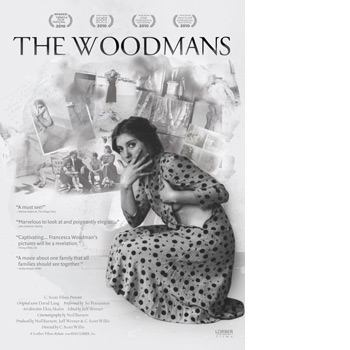
THE WOODSMANS: Provocative Portrait of Photographer Francesca Woodman and Her Artist Family


Documentary Had U.S. Theatrical Premiere Wednesday, January 19 at Film Forum

Francesca Woodman's haunting B&W images, many of them nude self-portraits, now reside in the pantheon of great photography from the late 20th century. The daughter of artists Betty and Charles Woodman (she a ceramicist and he a painter/ photographer), Francesca was a precocious RISD graduate, who came to New York with the intention of setting the art world on fire. But in 1981, as a despondent 22-year-old, she committed suicide.

THE WOODMANS beautifully interweaves the young artist's work (including experimental videos and diary passages) with interviews with the parents who have nurtured her professional reputation these past 30 years, while continuing to make art of their own in the face of tragedy. The film grapples with such issues as parent-child competition and the toxic level of ambition that fuels the New York art scene. It also has much to say about the healing powers of creativity. Winner of the Best New York Documentary award at the 2010 Tribeca Film Festival. —Karen Cooper, Film Forum

It's one of the fundamental questions of art. Who is a work of art ultimately about, the artist or the audience? In film we have the auteur theory, which argues that a movie is the creation of a single author, and that to understand that author is to better understand that movie. Our interpretation of Alfred Hitchcock's filmography and its recurring theme of wrongful imprisonment is enhanced by our knowledge of a story from Hitchcock's childhood; his father had him locked up in a local jail for a couple hours to teach him a lesson. Hitchcock was scarred for life, but that scar produced some wonderful movies. So that brings in a second fundamental question: are the best artists the ones who are the most emotionally damaged? Both of these questions are at the core the new documentary "The Woodmans," a thought-provoking look at one troubled family of artists and their need to express themselves. Francesca Woodman committed suicide at the age of 22 after producing some of the most fascinating photographs of the 20th century. Was her work a cry for help or simply a darkly beautiful point of view of the world? Did her need to compete with her parents, both artists themselves, compel her need to create? "The Woodmans" by director C. Scott Willis offers no simple answers to these questions. It isn't interested in absolving or indicting this family, but rather uses them as a case study to try to understand what makes an artist an artist. Husband and wife George and Betty Woodman have been married for 54 years. George is an abstract painter, Betty a potter. They had two children: Charles, who grew up to become an experimental electronic artist, and Francesca, a photographer. Francesca, arguably the most talented member of the family and inarguably the most emotionally troubled, killed herself in 1981. "The Woodmans" is filled with Francesca's photographs, which are moody and surreal images of nude women, many of whom were portrayed by Francesca herself. Betty believes her daughter's work was not autobiographical, but "The Woodmans" uses Francesca's photographs as the visual accompaniment to the story of her life up to and including George's recounting of his daughter final, tortured months, and they do not seem out of place in that context. But perhaps that's my interpretation, and not Francesca's intent. When Charles and Francesca were young, the Woodmans consumed art the way most families consume food: creating and studying it was absolutely essential to their existence. We imagine children's lives enriched by early exposure to culture. But maybe this particular family's zeal for art pushed past love into something closer to obsession. When the Woodmans would go to a museum, George says, Charles and Francesca would be given a notebook and a time and place to meet so he and Betty could enjoy the art "without the children around our necks." Director C. Scott Willis cuts between George and Betty's interviews and footage of the pair working on their art, juxtaposing their babies with their "babies." We see how incompatible an artist's life can be with a parent's life: the artist must be devoted entirely to one's self and one's impulses, which can leave little time or room for loved ones. Am I suggesting George and Betty neglected their daughter and are therefore responsible for her death? Absolutely not. But George and Betty have clearly wrestled with guilt over Francesca's suicide; in their darker hours, they may still wrestle with it ("Maybe I've been an absolutely horrible mother. I can't go back and rewrite it," Betty says at one point). Throughout the process Francesca herself remains something of a mystery, but that's appropriate given the fact that "The Woodmans" is about her family and friends reflecting back on her life and her work and trying to make sense of her decisions. Francesca's words, taken from her journals, leave nearly as large -- and nearly as ambiguous -- an impression as her photographs ("I am so vain and I am so masochistic. How can they coexist?"). Perhaps the most moving part of "The Woodmans" is George and Betty's creative reaction to Francesca's death. Both changed dramatically as artists -- maybe even improved as artists -- in the wake of the tragedy: George took up photography after years of abstract paintwork while Betty abandoned functional pottery for more whimsical creations. Now she has an enormous mixed media piece hanging in the new American embassy in China. Betty says the most common reaction she gets to her work these days is joy; when people talk about her art with her they say it makes them feel "better." The Woodmans may not believe in autobiographical impulses in artists' work. But that doesn't mean I can't see them in theirs.
Matt Singer IFC

Friday, January 14, 2011

Elmgreen & Dragset Fourth Plinth, Trafalgar Square, London 2012


Michael Elmgreen & Ingar Dragset are the winners of the Fourth Plinth, one of the most significant public art commission in Britain. Their work Powerless Structure, Fig. 101 will be exhibited in Trafalgar Square in London in 2012.

Sunday, January 09, 2011

RICHARD HAWKINS "THIRD MIND" OPENS AT HAMMER FEBRUARY 12, 2011


Richard Hawkins
Untitled (Slash/Twombly)
1992

Altered book; twofold leaves of plates. 12 x 8 1/2 in. (30.5 x 21.6 cm). Collection of Joel Wachs.

Martin Creed Ballet Work 1020.wmv

AI WEIWEI:NEVER SORRY TEASER

Ai Weiwei: Never Sorry TEASER from Ai Weiwei: Never Sorry on Vimeo.


The first feature length doc on the iconic Chinese contemporary artist, Ai Weiwei. Coming 2011.

Producer/Director:
Alison Klayman

Friday, January 07, 2011

MASS MOCA: AN EXCHANGE WITH SOL LEWITT


Daniel Joglar
Instruction, 2010
documented action

OPENS JANUARY 23-MARCH 31, 2011

The story of Sol LeWitt's exchanges with other artists is widely known. Though most artists engage in this process at one point or another, LeWitt seemed fully committed to it as an artistic code of conduct, a way of life. Eva Hesse, Robert Mangold, Hanna Darboven, and Robert Ryman are just a few of LeWitt's celebrated contemporaries with whom the artist exchanged works. Such exchanges were not limited to well-known artists -- LeWitt consistently traded works with admirers whom he did not know but who had nevertheless sent their work to him, as well as amateur artists with whom he interacted in his daily life. LeWitt's exchanges —- he responded to every work he received by sending back one of his own -— fostered an ongoing form of artistic communion and, in some cases, a source of support and patronage. The Sol LeWitt Private Collection retains all of the works he received, as well as a record of what he offered in return. For LeWitt, the act of exchange seemed to be not only a personal gesture, but also an integral part of his conceptual practice. In addition to encouraging the circulation of artworks through a gift economy that challenged the art world's dominant economic model, LeWitt's exchanges with strangers have the same qualities of generosity, and risk, that characterized his work in general. This kind of exchange was designed to stage an encounter between two minds, outside the familiar confines of friendship. If we consider the process of exchange as another of Sol LeWitt's instructional pieces, then the rational (or irrational) thing to do is to continue to exchange work and ideas, if only symbolically, with him. This exhibition, curated by Cabinet's Regine Basha, springs from a call to those who share an affinity with Sol LeWitt's legacy as a conceptual artist, to those who knew him and those who did not—to anyone who has ever wondered, "What would Sol LeWitt like?" Cabinet and MASS MoCA issued an open call for gifts to Sol LeWitt in any form of an image, an object, a piece of music, or a film, books, ephemera, and other non-perishable items (e.g. wine) for a two-part exhibition taking place at MASS MoCA and at the offices of Cabinet (300 Nevins Street in Brooklyn) from January 20- February 19, 2011. A publication documenting the contributions will accompany the shows and will be presented at the conclusion of the project to all participants.

"THE BROAD"


Billionaire philanthropist Eli Broad and his wife on Thursday unveiled long-awaited plans for a new museum in downtown Los Angeles that will house their collection of contemporary art. The museum, called "The Broad," features a honeycombed shaped facade, glass-enclosed lobby and three floors to display various works in their 2,000-piece collection. "The Broad" was designed by New York-based architects Diller, Scofidio + Renfro, and will be situated near the Frank Gehry-designed Walt Disney Concert Hall. The cost is estimated at around $130 million, and it is planned to open in 2013 with works by luminaries of contemporary and modern art including Jasper Johns, Andy Warhol and Roy Lichtenstein. Calling the concept the "veil and the vault," DS+R's design consists of a cast-concrete "veil" that wraps the building with a distinctive pattern and floods the interiors with that must-have for any museum: natural light. The second-story core of the building is the "vault" for the Broad Art Foundation, including Broad's massive collection -- over 2,000 works by 200 artists -- with windows that allow visitors to peek at the holdings as well as at the day-to-day operations of the foundation itself. The top floor features a completely sky-lit gallery that offers 24-foot ceilings and almost an acre of unobstructed gallery space.

Wednesday, December 29, 2010

HAPPY NEW YEAR: BRING IT ON!

TO OUR CLIENTS, COLLEAGUES AND DEAR FRIENDS HAPPY NEW YEAR FROM BARBARA BALKIN INC.


Rock 'N' Roll High School: The Ramones - Do You Wanna Dance?

Tuesday, December 07, 2010

THE ANDY WARHOL DIARIES

In this twittering world, Andy Warhol’s chronicle of his glimmering final decade seems pretty well scheduled for its republication. A star-studded (and stud-studded), gorgeously gossipy account of the Pop Art demi-God’s unyielding activity from 1976 until just days before his death in 1987, The Andy Warhol Diaries offer the sort of reading pleasure you’d get from poring over acres of salacious 1980s magazine print, only with the most famous artist of the period making gloriously catty asides about everybody over your shoulder the whole time. The most incredible thing about this catalogue of VIPs, VI-Parties and VI-Money Matters is how weirdly compelling it is, in spite of the flagrant laziness of the writing. Warhol never even so much as actually wrote any of the diary, as editor Pat Hackett explains in her introduction: the entire, breezeblock-thick thing is based on the rigorous regime of weekday morning phone calls that Warhol made to Hackett, faithfully recording his movements, anxieties and – in bogglingly minute detail – financial expenses. Edited from 20,000 pages down to the 1,123 published here, what Warhol’s testimonial lacks in art-theoretical analysis and probing psychological insight it more than makes up for in glamorous name-dropping, irreverent opinion and oddly fascinating glimpses into the life of this totemic enigma. Marvel at the crap Andy liked watching on telly, gasp at who was on which drugs at which party, cringe at the weird way that the wind at the World Trade Centre blew Jerry Hall’s underarm B.O. right up our diarist’s nose. The ‘Diaries now comes with a gratifyingly comprehensive index at the back, so you can speedily dip in and go straight to the entries on all your favourite celebs. They’re all in here: everyone who was anyone crops up somewhere in this massive and continually-pleasing labyrinth of the best possible tittle-tattle. The Andy Warhol Diaries isn’t just another good book, it’s an exhaustive, exhausting, dependably diverting friend for life.

Thursday, November 18, 2010

PATTI SMITH WINS NATIONAL BOOK AWARD

Tina Fineberg/Associated Press
The rock musician Patti Smith won the National Book Award for nonfiction on Wednesday night for “Just Kids,” a sweetly evocative memoir of her relationship with the artist Robert Mapplethorpe and life in the bohemian New York of the 1960s and ’70s. Accepting the award to applause and cheers, Ms. Smith — clearly the favorite of the night — choked up as she recalled her days as a clerk in the Scribner’s bookstore in Manhattan. “I dreamed of having a book of my own, of writing one that I could put on a shelf,” she said. “Please, no matter how we advance technologically, please don’t abandon the book. There is nothing in our material world more beautiful than the book.” “Just Kids” was published by Ecco, an imprint of HarperCollins.

Tuesday, November 16, 2010

Glenn O'Brien and  Rob Pruitt

The Solomon R. Guggenheim Museum is pleased to announce the nominees for Rob Pruitt's 2010 Art Awards, the second annual celebration honoring the notable individuals, exhibitions, and projects that have made a significant contribution to the field of contemporary art during the past year. Awards in 14 categories will be presented at a fundraising event to benefit the Guggenheim Foundation and visual arts non-profit White Columns on Wednesday, December 8, 2010, at the nightclub and music venue Webster Hall. Artist Rob Pruitt, whose conceptual practice is rooted in a pop sensibility and a playful critique of art world structures, conceived the event as a performance-based artwork which follows the format of a Hollywood awards ceremony. Designed by Pruitt with a flourish of showbiz glamour, the Art Awards harnesses the energy and accomplishments of the international arts community while simultaneously supporting two of its institutions.
Pruitt has invited writer, editor, and downtown fixture Glenn O'Brien to preside over the event as the Master of Ceremonies. Pruitt and O'Brien, along with writers David Colman and Linda Yablonsky, are penning the event script. A distinguished cast of presenters will participate in distributing award statuettes designed by Pruitt, including Bill Powers, Jeanne Greenberg Rohatyn, and Jerry Saltz of the television series Work of Art, who will announce "New Artist of the Year"; Mary Heilmann, the 2009 "Artist of the Year," who will announce the winner in that category; artist Marina Abramovic with Klaus Biesenbach, Director of MoMA PS1; artists John Currin and Rachel Feinstein; Richard Armstrong, Director, Solomon R. Guggenheim Foundation and Museum; and Matthew Higgs, Director, White Columns, among others. The evening will also feature performances by artists Martin Creed and Kalup Linzy, and surprise guest appearances. An after-party following the presentation will feature music by Rub-N-Tug. Lifetime Achievement Awards, determined by Rob Pruitt along with organizing partners the Solomon R. Guggenheim Museum and White Columns, will be awarded to Jonas Mekas and Martha Rosler. The Artist-Educator Achievement Award, a new distinction added for this year's celebration, will be presented to Marilyn Minter. A group of more than 1,000 artists and arts professionals were invited to form an anonymous Art Awards Council to nominate and then vote upon four nominees in categories that focus primarily on exhibitions and projects that took place over the past year (July 2009 to July 2010), in the United States, as well as one category recognizing an international exhibition. The Rob Pruitt Award is being decided solely by the artist. The winners in each of the twelve categories-in addition to the three Achievement Awards-will be announced at the live awards ceremony on December 8 at Webster Hall. The nominees for each category are:
Alternative Space of the Year
179 Canal, New York
Artists Space, New York
Cleopatra's, Brooklyn, New York
Light Industry, Brooklyn, New York

Alternative Project of the Year
Apartment Show, various locations, New York
edia Int'l Group, Foundation Barbin, New York
INDEPENDENT, New York
Jennifer Rubell, Creation, Performa 09, New York

Artist of the Year
Marina Abramovic
John Baldessari
Louise Bourgeois
Trisha Donnelly

Blogger or Critic of the Year
Howard Halle
Paddy Johnson
Jerry Saltz
Linda Yablonsky

Curator of the Year
Massimiliano Gioni
Laura Hoptman
Chrissie Iles
Neville Wakefield

Exhibition outside the United States
John Baldessari: Pure Beauty, Tate Modern, London
Rosemarie Trockel: Deliquescence of the Mother, Kunsthalle Zürich
Felix Gonzalez-Torres: Specific Objects without Specific Form, Wiels Contemporary Art Centre, Brussels
Matthew Barney: Prayer Sheet with the Wound and the Nail, Schaulager, Basel

Group Show of the Year, Gallery
Lush Life, various locations, New York
Picture Industry (Goodbye to All That), Regen Projects, Los Angeles
Primary Atmospheres: Works from California 1960-1970, David Zwirner, New York
Your History Is Not Our History: New York in the 1980s, Haunch of Venison, New York

Group Show of the Year, Museum
At Home/Not At Home: Works from the Collection of Martin and Rebecca Eisenberg, Hessel Museum of Art, Bard College, Annandale-on-Hudson, New York
Greater New York, P.S.1 Contemporary Art Center, Long Island City, New York
In & Out of Amsterdam: Travels in Conceptual Art, 1960-1976, Museum of Modern Art, New York
2010 Whitney Biennial Exhibition, Whitney Museum of American Art, New York 

New Artist of the Year
Michele Abeles
Tauba Auerbach
Liz Magic Laser
Ryan McNamara

The Rob Pruitt Award
To be announced the evening of December 8, 2010

Solo Show of the Year, Gallery
Claude Monet: Late Work, Gagosian Gallery, New York
Gelitin: Blind Sculpture, Greene Naftali Gallery, New York
Jonathan Horowitz: Go Vegan! Gavin Brown's Enterprise, New York
Trisha Donnelly, Casey Kaplan Gallery, New York

Solo Show of the Year, Museum
Marina Abramovic: The Artist Is Present, Museum of Modern Art, New York
Heat Waves in a Swamp: The Paintings of Charles Burchfield, Hammer Museum, Los Angeles, and Whitney Museum of American Art, New York
Otto Dix, Neue Galerie, New York
Yves Klein: With the Void, Full Powers, Hirshhorn Museum and Sculpture Garden, Smithsonian Institution, Washington, D.C., and Walker Art Center, Minneapolis

Proceeds from the 2010 Art Awards will benefit the Solomon R. Guggenheim Foundation and White Columns.

Friday, October 15, 2010

WOMEN THEN 1954 - 1969

Women Then 1954 - 1969
a new book by Jerry Schatzberg

The New York Photographer’s Ode to the Sirens of the 60s

Jerry Schatzberg began his career in fashion in the family business, manufacturing fur coats. Uninspired by his job he would take two-hour lunches to walk around the city and stare, intrigued, at cameras. After breaking free and assisting Bill Helburn, Schatzberg took to his own studio befriending, dating and capturing countless famous faces before segueing into feature films. In giving Al Pacino one of his first roles in the gritty Panic in Needle Park, documenting Faye Dunaway as a down-on-her-luck model in Puzzle of a Downfall Child, and hiring Gene Hackman in the Palm d'Or-winning Scarecrow, Schatzberg's movies were as successful as his photographs. Below he recounts shooting Warhol Superstar Edie Sedgwick in 1960. "It’s difficult to have a favorite image because I consider them all my friends. The Edie photograph, for example, was interesting because Albert Grossman––who was Bob Dylan’s manager at the time––wanted to represent her because she was quite a personality, but he didn’t know what for, so asked me to photograph her. Later I ran into Andy [Warhol] with the documentarian Barbara Rubin and I told him I was going to photograph Edie. By the time I got back to the studio, Barbara called and said Andy was wondering if I would shoot five minutes of footage for his film on Edie, and I said yes. Five minutes later she called again and said Andy’s wondering if he can shoot five minutes of you shooting five minutes, and I said yes. And then Barbara called once more and asked if she could film the shoot herself and bring a few people. I said yes. Before I knew it 40 people showed up at my studio, including most of the Velvet Underground! I always remember shooting my five minutes with Edie in the dressing room whilst Andy was shooting us. His assistant Gerard Malanga said, 'But Andy, there’s no film in the camera!' and Andy said, 'Oh, it doesn’t matter.' Then I politely threw them all out and did these photographs of Edie." 

Reported by Nowness


Wednesday, October 06, 2010

Printed Matter, Inc. presents The NY Art Book Fair


Thursday, November 4, 6-9 p.m.
Printed Matter, Inc. and The NY Art Book Fair will take over all three floors of MoMA PS1, November 5–7, to present 275 international presses, booksellers, antiquarians, museums, galleries, and artists from twenty-four countries, exhibiting the very best of contemporary art publishing. The Fair will open with a preview on Thursday, November 4 from 6-9 p.m. Admission to the preview and to the Fair is free.

www.nyartbookfair.com

Thursday, September 30, 2010

ArtAtWork | Painting Extravaganza


ART AT WORK
Via Mazzini, 40
10123 Torino
T.+39.011.19715285
F.+39.011.19715876
mail@artatwork.it
www.artatwork.it
 

Saturday, September 25, 2010

ROY LICHTENSTEIN IN THREE NY EXHIBITIONS

"Woman in Bath" (1963)
Credit: Estate of Roy Lichtenstein, Collection of H. Gael Neeson

Works by the Pop artist Roy Lichtenstein are on view in three separate exhibitions around Manhattan.
Roberta Smith writes: "Lichtenstein’s art forms an ode to the Americana of comic books and commercial art, but it has about it a brisk cosmopolitanism that is also New York at its most New York, which is in the fall. Perfect working order is what Lichtenstein was all about. And the loose-jointed survey of his economics afforded by these shows is all the more pleasant for being interrupted by large swaths of the city, which works pretty darned well in spite of everything. You can alternate views of Lichtenstein’s genius with healthy intakes of urban life and draw your own conclusions from the shows’ overlaps and discrepancies, whether with one another or reality." The most substantial effort is the Morgan Library & Museum’s brilliant “Roy Lichtenstein: The Black-and-White Drawings, 1961-1968,” which concentrates exclusively on the large finished drawings that heralded the arrival of his bold mature style. A broader view is taken by “Roy Lichtenstein: Mostly Men” at the Leo Castelli Gallery on the Upper East Side. Its 25 works concentrate on depictions of men, skimming across a career more identified with anxious young women. And in Chelsea, Mitchell-Innes & Nash rounds out the bill with “Roy Lichtenstein Reflected,” which features 10 paintings, mostly from the late 1980s and early ’90s, that one way or another depict mirrors. While more routine it gets to the heart of Lichtenstein’s concerns. As each show has its own catalog, a kind of Lichtenstein Festschrift also accrues.
Reported in NY Times

Tuesday, September 21, 2010

PETER AND STEPHANIE HAPPY AT LAST


All couples go through some rough patches, but when the husband is a billionaire publishing tycoon/polo player/art collector and the wife is a glamorous Victoria's Secret model/artist’s muse, people tend to gossip. And when private squabbles turn into a vicious public divorce, complete with allegations of drug use and domineering personalities, there’s no stopping wagging tongues. Well, all the schadenfreuders out there eagerly awaiting the outcome of yesterdays divorce trial between Peter Brant and Stephanie Seymour (What was going to happen to all the art?!) were shocked into silence when the pair walked into court hand-in-hand and told the judge, actually, they’ll be staying married, nevermind. The newly reunited couple, who have been married for 15 years and have three children, received some parting advice from Superior Court Judge Lynda Munro, who reportedly said, “After the first hearing with you, I said I thought you were going to reconcile and I'd forgotten about it… I'm a true believer in marriage. It's hard work growing old together, but it's actually sort of fun." It’s always nice to see a family—and an art collection—stay together.

Saturday, September 18, 2010

TATE MODERN: The Unilever Series: Ai Weiwei


Ai Weiwei
Han Dynasty Urn with Coca-Cola Logo 1994
Courtesy the artist © Ai Weiwei
Han Dynasty urn, paint
25.4x27.9x27.9cm

The Unilever Series: Ai Weiwei
12 October 2010  –  2 May 2011

The Chinese artist has become one of the most important cultural commentators of his generation. Ai Weiwei who designed Beijing's 'Bird's Nest' Olympics stadium is no gentle character. A notable artist, commentator, activist, blogger and a powerful voice on Twitter, his art and social commentary have shocked the world. 

Thursday, September 09, 2010

ROB PRUITT PATTERN AND DEGRADATION


ROB PRUITT PATTERN AND DEGRADATION
SEPTEMBER 11 – OCTOBER 23, 2010
Opening Reception: September 11, 6-8 PM
Gavin Brown’s enterprise
620 Greenwich Street New York, NY 10014
Maccarone
630 Greenwich Street New York, NY 10014

Rob Pruitt is the artist for our time, creating and living at a moment when the American experience is both preeminent and stagnant. Rather than feel defeated by the diminished cultural legacy left to us, Pruitt has embraced it. He loves the cynicism, bathes in the stupid, lies down with the empty, turns the other cheek, and asks for an autograph. He has no answers, so he offers a joyful moment of flat, ridiculous glitter. His love of life and seeming flippancy are forms of modern wisdom - a radical, smiling response to an intolerable situation and a giddy challenge to those who have given in.

Tuesday, June 29, 2010

MISSING IN ART


Returning in the Fall!!

Photo: Ryan McGinley

Wednesday, June 16, 2010

THE NEW DECOR : HAYWARD GALLERY, LONDON


The New Décor: Artists & Interiors
www.southbankcentre.co.uk/decor
June 19th- September 5, 2010

An international survey of over 30 contemporary artists, including some of the leading sculptors of our time, who explore interior design as a means of engaging with changes in contemporary culture. By reconfiguring and reinventing the familiar objects of our domestic life, these artists look beyond design and function to create provocative sculptures and installations. The exhibition features work by 30 artists including: Martin Boyce (Britain), Los Carpinteros (Cuba), Jimmie Durham (USA), Elmgreen & Dragset (Scandinavia), Gelitin (Austria), Mona Hatoum (Lebanon), Jim Lambie (Britain), Sarah Lucas (Britain), Ernesto Neto (Brazil), Ugo Rondinone (Switzerland), Doris Salcedo (Colombia), Rosemary Trockel (Germany), Tatiana Trouve (Italian), Franz West (Austrian). Curated by Ralph Rugoff, Director of the Hayward Gallery, the exhibition draws on artists from around the world, but what unites them is their ability to transform objects we associate with the everyday – a bed, a shelf, a lamp – into something uncanny and compelling.

Monday, June 14, 2010

FRIEZE PROJECTS 2010 ANNOUNCED


Frieze Projects is a program of newly commissioned artworks by international artists realized annually at the Frieze Art Fair every October in Regent's Park, London. It is curated by Sarah McCrory and, this year, includes nine specially commissioned projects as well as the Cartier Award. The artists commissioned to create these site-specific works for Frieze Art Fair are Ei Arakawa and Karl Holmqvist, Spartacus Chetwynd, Matthew Darbyshire, Shannon Ebner and Dexter Sinister, Gabriel Kuri, Shahryar Nashat, Nick Relph, Annika Ström and Jeffrey Vallance. This year’s program of commissioned projects includes elements of performativity – either directly, with performances taking place in and around the fair, or more obliquely, commanding a level of involvement from visitors. Ranging from the spectacular to the intimate, the emphasis is on a direct engagement that will rest upon a series of personal encounters. The Cartier Award 2010 recipient is Simon Fujiwara. Fujiwara will present Frozen; an installation based on the fictive premise that an ancient lost city has been discovered beneath the site of the fair. Throughout the fair, visitors will encounter archaeological digs, displays of found artefacts and graphic panels describing a historic civilization that was once a hub of art and commerce.

Saturday, June 12, 2010

SIGMAR POLKE DIES AT 69

European Pressphoto Agency / April 7, 2005

Sigmar Polke, one of Germany’s best-known artists, died Thursday night from cancer at the age of 69.  Polke, a painter, graphic artist and photographer, was “one of the most important and most successful representatives of German contemporary art and had an important international reputation. The record price for Polke’s work at auction was 2.7 million pounds (then $5.3 million) for a 1966 canvas titled “Strand” (Beach) that sold at Christie’s in London in 2007. Stephanie Barron, curator of modern art at LACMA who included Polke in the 2009 show "Art of Two Germanys/Cold War Cultures," called him "one the most important painters of the postwar generation and a leader among German artists." Born in 1941 in eastern Germany, Polke emigrated to the west in 1953. He settled in Dusseldorf, where he studied at the Art Academy. In 1963, he founded the “Capitalist Realism” painting movement with Gerhard Richter and Konrad Lueg. The three artists mocked both the realist style that was the official art of the Soviet Union and the consumer-driven pop art of the west. Polke moved to Cologne in 1978. He experimented with a wide range of styles, subject matter and materials. In the 1970s, he concentrated on photography, returning to paint in the 1980s, when he produced abstract works created by chance through chemical reactions between paint and other products. In the last 20 years, he produced paintings focused on historical events and perceptions of them. Polke was "incredibly adept at blending together images taken from many different sources," Barron said. "In his paintings he would bring together images from advertising, newspapers, film stills, and more in an incredibly eloquent and layered way." Nicholas Serota, director of London's Tate Modern art gallery, said Polke's "sublimely beautiful paintings" often carried a "tough message about society and its values" and were enormously influential on younger generations of artists. 

Monday, June 07, 2010

Marina Abramovic Answers $64,000 ? "HOW DID I PEE?"

Marina Abramovic, the performance artist whose retrospective closed at the Museum of Modern Art on Memorial Day, last night answered what she said was the number one question about her performance in the exhibit, in which she sat in the museum's atrium facing museum visitors all day every day during the exhibit's run: "How did I pee?" In her MoMA performance, called, as was the retrospective, Abramovic sat in an armless chair, on a pillow, facing an individual visitor--the famous like Sharon Stone, Lou Reed, James Franco, Isabella Rossellini, Marisa Tomei and Bjork, but, more often, the not-so-famous--who sat in the same kind of chair; initially they were separated by a table, which was later removed. Speaking at MoMA, surrounded by 36 performance artists who, during the retrospective, recreated her pieces on the museum's sixth floor, Abramovic said her chair had a "little hole." After three days of sitting on it, she said it became "so clear to me I will never use it. I never have the urge to pee, I sat on a pillow." To prepare for her marathon performance--her longest to date, 716.5 hours long, with Abramovic facing 1,545 visitors--the artist said she became a vegetarian (something she normally is not) six months before the exhibit, eating light food based on grains. And she said she trained herself to wake up every 45 minutes at night to drink water and remain hydrated. Abramovic also explained her fashion choices during the marathon. She said the blue dress she wore during the first month "calmed" her mind; "my brain was moving 360,000 miles per hour." The red dress the second month symbolized the "enormous amount of physical pain" she was experiencing, particularly from her armless chair--which she said she would change if she were to perform the piece again--and her legs swelling. The white dress, worn during the final month, represented "clarity, the immaterial." Abramovic also said her eyes created "incredible problems," but that she walked out on a doctor whom she consulted when he asked, "Why are you doing this to your eyes?" Klaus Biesenbach, curator of the Abramovic exhibit, said the artist called him on April 30 to ask if she could remove the table separating her from museum visitors, "to be directly with the audience." Although he said he had some misgivings about this, "Marina took it away." Asked if she could reperform "The Artist is Present," Abramovic said, "Of course we could reperform it. It's really a kind of piece about awareness, stillness. It opened the door to me to aspects of performance."
Jane Levere: Huffington Post

Thursday, June 03, 2010

Jeff Koons Unveils Art Car That Will Race At Le Mans


Artist Jeff Koons unveiled the BMW Art Car that will carry his colorful paint job in this month’s 24-hour race at Le Mans, France. The race car, a BMW M3 GT2, competes in a popular category that includes Ferraris, Porsches and other production-based sports vehicles that most drivers would recognize. The Art Car will be part of a two-car team competing at Le Mans, where many other Art Cars have raced. The Koons racer is certain to be noticed on the track. Its bright, streaked paint job suggests motion, as if paint was thrown at the car as it passed. Up close, though, the color scheme is full of intricate detail. The M3 GT2 is the 17th Art Car BMW has produced since commissioning Alexander Calder to paint the first one in 1975. Many artists including Roy Lichtenstein, Frank Stella and Andy Warhol have designed Art Cars for BMW. Typically the artist created the design through sketches and models, and BMW does the actual painting. Andy Warhol is the only one who painted the car himself. 
By Jonathan Welsh: WSJ

Wednesday, June 02, 2010

ROLE MODELS BY JOHN WATERS

                                                 Frank Klein

Leave it to John Waters to write what is perhaps the first loving, learned homage to outsider pornographers. In one chapter of his new memoir, Role Models (Farrar, Straus & Giroux), Waters introduces Bobby Garcia, "the Almodóvar of Anuses, the Buñuel of Blow Jobs, the Jodorowsky of Jerking Off." Garcia--who has somehow convinced thousands of straight Marines to star in gay porn--lives in a run-down shack overflowing with pigs, roosters, and hundreds of rats. But to Waters he is a genius. Role Models is a paean to the people Waters claims as influences, but not all are so predictably perverse. In it, he reminisces about artist Cy Twombly and Clarabell the Clown from The Howdy Doody Show, Tennessee Williams and Patty McCormack, the actress who portrayed the murderous little girl in 1956's The Bad Seed. And aside from one serious, soul-searching chapter--about Manson girl and convicted murderer Leslie Van Houten--the book is surprisingly charming and riotously funny. It's an especially good read for those familiar with Waters' hometown, a city "filled with nutcases who think they are totally levelheaded." Baltimore's own aficionado of filth names many Charm City natives as inspirations. There's Lady Zorro the lesbian stripper, who would come out on stage naked and snarl, "What the fuck are you looking at?" There's Esther Martin, the foul-mouthed founder of the Club Charles, who inspired her daughters with such inspirational adages as "A cunt hair will pull a twenty-mule team." And Waters devotes a good deal of his chapter on Baltimore heroes to his favorite scary bars, most of which--Hard Times, Morgan's, Boots--are no more.
But beneath Waters' exuberant, bawdy prose lies a challenge. "Filth is just the beginning battle in the war on taste," he writes. Parts of Role Models are, of course, shocking, some in the same sense as a certain famous scene in his classic movie Pink Flamingos. (In the book, the author wonders if it is as draining for Johnny Mathis to sing "When Sunny Gets Blue" over and over again as it is for Waters to have fans ask him repeatedly whether Divine really ate dog shit.) But the affectionate, respectful tone Waters takes with each profile--whether of a famous fashion designer or an unknown coprophiliac--is a deeper transgression. After reading the book, you feel that his fascination with those on society's periphery is accompanied by real empathy, a generosity of spirit that most of us cannot fathom.
Leslie Van Houten is perhaps the most notorious recipient of that compassion. At the age of 19, in the thrall of Charles Manson, she participated in the bloody murder of the LaBianca family. She is still in prison, and Waters devotes a long chapter in his book to her story and the story of their friendship. She is repentant and fully rehabilitated, he writes, and deserves to be given parole. The chapter is neither scandalous nor simplistic. It discusses the limits of redemption, the nature of accountability, and the purpose of imprisonment. And it reveals another side of John Waters, the repentant one. He writes that he is "[g]uilty of using the Manson murders in a jokey, smart-ass way in my earlier films without the slightest feeling for the victims' families or the lives of the brainwashed Manson killer kids who were also victims in this sad and terrible case." Role Models covers a great deal of strange, seemingly unrelated ground. It leaps directly from Van Houten to a section on Waters' wardrobe, a style he calls "disaster at the dry cleaners." After perusing "John Waters's Five Books You Should Read to Live a Happy Life if Something Is Basically the Matter With You," you're whisked to a drab hotel room inhabited by Little Richard. You'd think this eccentric narrative wouldn't hold together. But the book is, somehow, a brilliant self-portrait. It's a little like one of those photo mosaics so popular of late: Up close, it's a jumble of tiny colorful portraits. Step back, and there's the Pope of Trash himself.
Baltimore CityPaper