Wednesday, April 20, 2011
DOUGLAS GORDON'S EXHIBITION "PHANTOM"
Douglas Gordon is one of the most highly regarded British video-artists and the first to win the Turner prize. Using film and video as a means to experiment with identity and the mechanics of memory, his work abstracts film images to provide an alternative experience of human observation. In the artist’s sixth exhibition at the Yvon Lambert gallery in Paris, Phantom features three autobiographical installations. A half destroyed neon work titled Unfinished, featuring the words “I am the centre of the world”, and a series of four hundred framed works - an open diary of Douglas’ personal belongings – delves into the dark depths of the artists vulnerability through the objectification in their exposure. Phantom – the main body of this collective, is a collaborative work with singer-songwriter Rufus Wainwright. Surrounded by mirrors and a grand piano, a video of Wainwright’s eye plays in darkness, inviting observers to question the fragmented and torturous nature of self.
Phantom, Yvon Lambert, 108 rue Vieille-du-Temple, 75003, Paris, until June 3
Thursday, April 07, 2011
NEW MUSEUM GALA
Gilbert and George
Photographer: Amanda Gordon/Bloomberg
Amanda Gordon of Bloomberg reports: There were many happy pairs at the New Museum Spring Gala in Manhattan’s financial district last night. The couples garnering the most attention were the event’s honorees: collectors Gael Neeson and Stefan Edlis and the artists Gilbert & George, who have been working, dressing and talking in sync since the 1960s. The duos accepted their awards at a Lucite lectern. “We are so happy that we are smiling at both ends,” Gilbert & George said in unison. The party, on the 45th floor of 7 World Trade Center, brought in $1.3 million. Sotheby’s, auctioned off a photographic portrait-sitting with Chuck Close for $250,000. The 33 collages that Josh Smith made for the gala, some of which were exhibited next to a red carpet as guests arrived, sold out.
Photographer: Amanda Gordon/Bloomberg
Amanda Gordon of Bloomberg reports: There were many happy pairs at the New Museum Spring Gala in Manhattan’s financial district last night. The couples garnering the most attention were the event’s honorees: collectors Gael Neeson and Stefan Edlis and the artists Gilbert & George, who have been working, dressing and talking in sync since the 1960s. The duos accepted their awards at a Lucite lectern. “We are so happy that we are smiling at both ends,” Gilbert & George said in unison. The party, on the 45th floor of 7 World Trade Center, brought in $1.3 million. Sotheby’s, auctioned off a photographic portrait-sitting with Chuck Close for $250,000. The 33 collages that Josh Smith made for the gala, some of which were exhibited next to a red carpet as guests arrived, sold out.
LE JARDIN MAJORELLE, MARRAKECH
Amidst the bustling, eclectic ambience of the souks & kasbahs of Marrakech stands one of North Africa’s most diverse, abundant gardens – the JARDIN MAJORELLE – a tranquil haven conceived by the artist Jacques Majorelle in 1924. Opened to the public in 1947 and acquired by the fashion designer YVES SAINT LAURENT and his partner PIERRE BERGÉ in 1980, the garden remains a public attraction today – offering a rare glimpse into this rich and intriguing fusion of traditional and European design of the early 20th century. The 1931 villa nestled within the grounds is rendered in a rich cerulean blue (a customary local color that was henceforth labelled ‘bleu majorelle’ after the artist’s liberal use of the tone attracted international attention). Originally drawn up by architect Paul Sinoir as ‘the blue workshop’, the building currently houses the Islamic Art Museum.
Wednesday, April 06, 2011
Ai Weiwei is investigated by Chinese police for 'economic crimes'
Authorities acknowledge police action against artist but still no word about his friend, Wen Tao.
An ominous editorial in the Chinese state-run Global Times newspaper stated, “Ai Weiwei . . . has been close to the red line of Chinese law. As long as Ai Weiwei continuously marches forward, he will inevitably touch the red line one day.” “Ai Weiwei will be judged by history, but he will pay a price for his special choice,” it added. The newspaper also hinted that Ai had infringed the law by attempting to fly from Hong Kong to Taiwan without completing his “departure procedures.” Chinese citizens require a special permit to visit the island. Ai's friends said Ai had steeled himself for such an outcome after years of criticizing the government. Hao Guang, a fellow artist in Beijing, said Ai “has known for a long time this day was coming.”
Tuesday, April 05, 2011
AI WEIWEI'S NEW YORK PROJECT TO GO ON
A large-scale public art project by the Chinese artist Ai Weiwei, to occupy the Pulitzer Fountain outside the Plaza Hotel starting early next month, will go forward even if Ai, who was detained by the Chinese authorities on Sunday, is unable to be present, reports Robin Pogrebin for the New York Times. Ai’s twelve-piece sculpture, Circle of Animals/Zodiac Heads, is scheduled to be displayed from May 2 and through July 15 at Fifty-Ninth Street and Fifth Avenue. It is the first major outdoor exhibition to be presented on the site of the fountain, according to the organizers. The installation was inspired by the fabled fountain-clock of the Yuanming Yuan, an eighteeth-century imperial retreat just outside Beijing. Designed by two European Jesuit missionaries at the behest of the Manchu Emperor Qianlong, the clock featured each animal of the Chinese zodiac spouting water at two-hour intervals. In 1860 French and British troops ransacked the Yuanming Yuan, pillaging the heads. Seven of them—the rat, ox, tiger, rabbit, horse, monkey and boar—have since been located. In a series of interviews for a book about the project, Ai said New York was particularly suited to his sculpture. “It’s not one kind of people,” he said, adding that its residents came from all over the world and included many minorities. “It’s a zodiac city.”
"But because Circle of Animals/Zodiac Heads is animal heads, I think it’s something that everyone can have some understanding of, including children and people who are not in the art world. I think it’s more important to show your work to the public. That’s what I really care about. When Andy Warhol painted Mao in the 1960s and 1970s, I don’t think many people understood Mao, either—it was just this image that people knew, like Marilyn Monroe or somebody. So they might see these zodiac animals like that—like Mickey Mouse. They’re just animals. Eleven real animals and one mystic animal." Ai Weiwei
AI WEIWEI STILL MISSING
Ai Weiwei, detained by the Chinese authorities and unreachable since 3 April, has joined a select band of artists who have risked everything for their ideals. Ai Weiwei joins a select band of artists who have risked everything for ideals. Michelangelo was arguably the first dissident artist when he created fortifications for the revolutionary republic of Florence in 1529: in fact, he and Ai Weiwei have something in common as artists who work on a grand public scale. You could call the floor of the Tate Turbine Hall a modern equivalent of the Sistine Chapel ceiling, in both fame and impact. In the 19th century, the tough realist painter Gustave Courbet joined the Paris commune and died in exile for his ideals: again, like Ai Weiwei and Michelangelo, he was a charismatic personality who seemed too big to be brought down. But he was cruelly punished. Will Ai Weiwei be a Courbet or a Michelangelo? While the Communard painter was ruined by his political enemies, Michelangelo was spared and allowed to carry on working and enjoying his success after the defeat of the Florentine rebellion – he really was too big to hurt. We have to hope that the state will release Ai Weiwei and his fame will continue to protect him. Whatever happens, he is that rare thing: the artist as moral and political hero. Britain, the United States and the European Union, as well as leading figures in the art world, have joined the growing international outcry over his detention and Beijing's wider crackdown on dissidents and activists. Ai's wife, Lu Qing, told Reuters: "This time it's extremely serious. They searched his studio and took discs and hard drives and all kinds of stuff, but the police haven't told us where he is or what they're after."
Excerpt: The Guardian
Wednesday, March 30, 2011
ROB PRUITT UNVEILS THE ANDY MONUMENT TONIGHT
Public Art Fund
presents ...
Rob Pruitt
The Andy Monument
March 30 - October 2, 2011
Union Square
(17th Street and Broadway)
Unveiling:
March 30, 2011
6:00pm
' You know the song "New York, New York," and how for year after year people have come to New York to "make it." One of the most important examples of that is Andy Warhol, who spawned a generation of people who think they can make it here in this city. Andy Warhol embodies the spirit of the city that still draws people. Every day a thousand more kids come to New York propelled by his legacy. And even if the decades pass and Warhol becomes a vaguer and vaguer character, there will still be something here that's directly linked to him - this pilgrimage, or calling, coming here from the Midwest, Eastern Europe or South- East Asia, to make it big, to be an artist. I think there should be a destination in New York to mark all those journeys. There are hundreds of monuments to politicians in the New York City, but I can’t think of any monuments to artists, and other figures who actually represent the lived experience of most of the people who live here. When I was a teenager, I visited Pere Lachaise cemetery in Paris, where Jim Morrison and Oscar Wilde are buried. I was struck by the throngs of people that came to visit the tombs of their idols. When Andy Warhol died, his family had his remains sent back to Pittsburgh, where he was born, and so no such marker for him exists in New York. So a public statue of Warhol has a sense of righting a wrong. Andy, like so many other artists and performers and people who don’t fit in, moved to New York to be himself, fulfill his dreams and make it big. That’s why I moved here, and that’s what my Andy Monument is about. Of course it could be argued that someone could just go to the Modern and look at his Soup Cans, but I think there is something to being truly out in streets of New York, to have something you can visit at 4:20 in the morning with your friends.
I will be unveiling the Andy Monument at the North-West corner of Union Square on Wednesday, March 30 at 6:00PM. I hope you will be able to join me to celebrate one of our own. '
Rob Pruitt
New York
March 2011
presents ...
Rob Pruitt
The Andy Monument
March 30 - October 2, 2011
Union Square
(17th Street and Broadway)
Unveiling:
March 30, 2011
6:00pm
' You know the song "New York, New York," and how for year after year people have come to New York to "make it." One of the most important examples of that is Andy Warhol, who spawned a generation of people who think they can make it here in this city. Andy Warhol embodies the spirit of the city that still draws people. Every day a thousand more kids come to New York propelled by his legacy. And even if the decades pass and Warhol becomes a vaguer and vaguer character, there will still be something here that's directly linked to him - this pilgrimage, or calling, coming here from the Midwest, Eastern Europe or South- East Asia, to make it big, to be an artist. I think there should be a destination in New York to mark all those journeys. There are hundreds of monuments to politicians in the New York City, but I can’t think of any monuments to artists, and other figures who actually represent the lived experience of most of the people who live here. When I was a teenager, I visited Pere Lachaise cemetery in Paris, where Jim Morrison and Oscar Wilde are buried. I was struck by the throngs of people that came to visit the tombs of their idols. When Andy Warhol died, his family had his remains sent back to Pittsburgh, where he was born, and so no such marker for him exists in New York. So a public statue of Warhol has a sense of righting a wrong. Andy, like so many other artists and performers and people who don’t fit in, moved to New York to be himself, fulfill his dreams and make it big. That’s why I moved here, and that’s what my Andy Monument is about. Of course it could be argued that someone could just go to the Modern and look at his Soup Cans, but I think there is something to being truly out in streets of New York, to have something you can visit at 4:20 in the morning with your friends.
I will be unveiling the Andy Monument at the North-West corner of Union Square on Wednesday, March 30 at 6:00PM. I hope you will be able to join me to celebrate one of our own. '
Rob Pruitt
New York
March 2011
Friday, March 25, 2011
Congratulations Urs and Christel Raussmuller
Robert Ryman and Urs Raussmüller: A Public Conversation
The founders of the Hallen für Neue Kunst, Urs and Christel Raussmüller, are receiving an award for their extraordinary cultural achievements by the Swiss Foundation for the Doron Prize. The Hallen für Neue Kunst will be awarded the Doron Prize 2011 for its unique concept in content and architecture; it serves as a model world-wide. The privately run Hallen für Neue Kunst has been making high calibre works of European and American “New” Art accessible to the public for over 25 years. The special thing about the “Hallen” is its holistic concept that brings art and space together in a convincing way. In the Hallen für Neue Kunst’s inspiring atmosphere, major works from the ground-breaking period around 1965 can realize the entire potential of their creative radiance in an exemplary, long-term presentation context. Artists such as Robert Ryman, Bruce Nauman, Mario Merz, Joseph Beuys, Sol LeWitt or Carl Andre, among others, can be permanently experienced in representative work groups. As the “Schaffhausen model” and the first uncompromising transformation of an industrial building into an art institution, the Hallen für Neue Kunst is seen as a museum that reflects artists’ needs. The Hallen für Neue Kunst is highly recognized far beyond Swiss borders; it has inspired numerous projects, among them the Tate Modern in London or the Andy Warhol Museum in Pittsburgh.
The award ceremony will take place in Zug on March 30th on invitation by the Swiss Foundation for the Doron Prize.
Raussmüller Collection
Hallen für Neue Kunst
Baumgartenstrasse 23
CH-8200 Schaffhausen
T. +41 (0)52 625 25 15
F. +41 (0)52 625 84 74
www.modern-art.ch
www.raussmueller-collection.ch
Hallen für Neue Kunst
Baumgartenstrasse 23
CH-8200 Schaffhausen
T. +41 (0)52 625 25 15
F. +41 (0)52 625 84 74
www.modern-art.ch
www.raussmueller-collection.ch
Thursday, March 24, 2011
Wednesday, March 23, 2011
MARTIN CREED AT NASHER SCULPTURE CENTER
Martin Creed, will create a site-specific installation , on view from March 26 through June 19, 2011 at the Nasher Sculpture Center in Dallas, Texas. Creed will transform the space by filling it with colored balloons to a height of about 8 feet. Related to earlier installations such as Work No. 628: Half the air in a given space from 2007, the balloons enclose and make visible portions of the volume of air in the room, as well as drastically alter one's physical experience of the space.
Tuesday, March 22, 2011
Patrick Cariou wins copyright case against Richard Prince and Gagosian
Cariou v Prince: Left, a photo of a Rastafarian from Patrick Cariou's "Yes, Rasta" and, right, a painting from Prince's Canal Zone series
New York. A US District judge has ruled in favour of photographer Patrick Cariou in his copyright lawsuit against artist Richard Prince.
Cariou originally filed suit for copyright infringement against Prince, Larry Gagosian, Gagosian Gallery, and Rizzoli books in December 2008 after a number of his photographs were reappropriated without consent in Prince’s “Canal Zone” series. The photographs first appeared in Cariou’s 2000 publication, Yes, Rasta, a photographic book produced after spending six years documenting Jamaican Rastafarians. Prince “admits to using at least 41 photos from Yes, Rasta”, according to the judge’s decision, but had claimed “fair-use” for transforming the original works, as opposed to creating derivative images. US District Judge Deborah Batts has granted Cariou’s motion for summary judgement on the issue of copyright infringement and ordered the defendants to “deliver up for impounding, destruction, or other disposition, as Plaintiff determines, all infringing copies of the photographs, including the paintings and unsold copies of the Canal Zone exhibition book, in their possession, custody, or control and all transparencies, plates, masters, tapes, films, negatives, discs and other articles for making infringing copies.”
The defendants must also notify in writing any current or future owners of the paintings to inform them that the works infringe Cariou’s copyright, and “were not lawfully made under the Copyright Act of 1976, and that the paintings cannot be lawfully displayed”. At its heart, the case focuses on Prince and Gagosian’s “fair use” defense. This legal doctrine is intended to mediate between the First Amendment and the Copyright Clause, which are “intuitively in conflict”, according to the judge’s decision. Four factors determine fair use. Firstly, “the purpose and character of the use,” ie the extent to which the new work is transformative. However, rather than adding value solely through transforming elements of the original, the new work must comment on the original in some way, and create something “plainly different from the original purposes for which it was created”, according to the judge’s decision, which refers to the landmark copyright case of Rogers versus Koons: “If the infringement of copyrightable expression could be justified as fair use solely on the basis of the infringer’s claim to a higher or different artistic use...there would be no practicable boundary to the fair use defense.” In the earlier case, Koons failed to prove that his “parody” of an image of a couple surrounded by puppies, by commercial photographer Art Rogers, constituted fair use. After noting Prince’s testimony that “he didn’t really have a message” and did not attempt to comment on any aspects of the original, the judge ruled that “there is vanishingly little, if any, transformative element.” The less transformative a work, the more important its commerciality becomes. The papers quote Gagosian’s sales figures to determine that the “defendants use and exploitation of the photos...was substantially commercial...[which] weighs against fair use”. Gagosian had sold eight of the Canal Zone paintings for a total $10.48m, 60% of which went to Prince, with the remainder to the gallery. Seven other paintings were exchanged for art “with an estimated value between $6m and $8m,” according to court papers. Gagosian gallery also sold $6,784 worth of exhibition catalogues. “Bad faith” is also taken into consideration. Despite instructing an assistant to contact Cariou’s publisher to buy extra copies of Yes, Rasta, Prince never asked “about licensing or otherwise sought permission to use” the images. “Prince’s bad faith is evident,” ruled Judge Deborah Batts.
The second element is the “nature of the copyrighted work”. The defendants had questioned Cariou’s copyright of the images, asserting that his “photos are mere compilations of facts...arranged with minimum creativity.” The judge ruled against this: “Unfortunately for defendants, it has been a matter of settled law for well over 100 years that creative photographs are worthy of copyright protection,” found the judge.
The third issue taken into consideration in the fair use defense is the “amount and substantiality of the portion of the copyrighted work used”. The judge found that, by appropriating the central figures in Cariou’s publication, Prince had gone “to the very heart of his work. Accordingly, the amount of Prince’s taking was substantially greater than necessary, given the slight transformative value of his secondary use...[which] weighs heavily against...fair use.”
The final deciding factor is the extent to which Cariou’s real and potential markets had been harmed by Prince’s appropriation. The defendants’ claims that “Cariou has not marketed his photos more aggressively (or, indeed, as aggressively as Prince has marketed his paintings) are unavailing,” found Judge Batts, who said that Cariou’s potential market had been “usurped”. Cariou’s real market was also effected after Manhattan gallerist Christiane Celle cancelled a scheduled exhibition of prints from Yes, Rasta because she did “not want to be seen to be capitalizing on Prince’s success and notoriety...and did not want to exhibit works which had been ‘done already’ at another gallery”, according to the papers.
The “Gagosian defendants” were also found “directly liable for copyright infringement” by distributing images of and selling paintings from Canal Zone. In addition, all Gagosian defendants were found as “vicarious and contributory infringers” after the judge ruled the they had “at the very least the right and ability (and perhaps even responsibility) to ensure Prince obtained licenses”. She added: “The financial benefit of the infringing use to the Gagosian defendants is self-evident.”
Cariou had also claimed for conspiracy under the Copyright Act, which was dismissed.
In an emailed statement, a Gagosian spokeswoman said: “Gagosian Gallery declines to comment on the Court’s decision at this juncture. Gagosian remains committed to the promotion of the arts through its continued support of artistic freedom in the studio for appropriation artists, such as Richard Prince, the creator of the Canal Zone series.” It is not known whether the gallery or Prince will appeal the decision.
All parties are due to appear in court on 6 May for a status conference to settle damages and fees.
The Art Newspaper
By Charlotte Burns | Web only
Published online 21 Mar 11 (News)
New York. A US District judge has ruled in favour of photographer Patrick Cariou in his copyright lawsuit against artist Richard Prince.
Cariou originally filed suit for copyright infringement against Prince, Larry Gagosian, Gagosian Gallery, and Rizzoli books in December 2008 after a number of his photographs were reappropriated without consent in Prince’s “Canal Zone” series. The photographs first appeared in Cariou’s 2000 publication, Yes, Rasta, a photographic book produced after spending six years documenting Jamaican Rastafarians. Prince “admits to using at least 41 photos from Yes, Rasta”, according to the judge’s decision, but had claimed “fair-use” for transforming the original works, as opposed to creating derivative images. US District Judge Deborah Batts has granted Cariou’s motion for summary judgement on the issue of copyright infringement and ordered the defendants to “deliver up for impounding, destruction, or other disposition, as Plaintiff determines, all infringing copies of the photographs, including the paintings and unsold copies of the Canal Zone exhibition book, in their possession, custody, or control and all transparencies, plates, masters, tapes, films, negatives, discs and other articles for making infringing copies.”
The defendants must also notify in writing any current or future owners of the paintings to inform them that the works infringe Cariou’s copyright, and “were not lawfully made under the Copyright Act of 1976, and that the paintings cannot be lawfully displayed”. At its heart, the case focuses on Prince and Gagosian’s “fair use” defense. This legal doctrine is intended to mediate between the First Amendment and the Copyright Clause, which are “intuitively in conflict”, according to the judge’s decision. Four factors determine fair use. Firstly, “the purpose and character of the use,” ie the extent to which the new work is transformative. However, rather than adding value solely through transforming elements of the original, the new work must comment on the original in some way, and create something “plainly different from the original purposes for which it was created”, according to the judge’s decision, which refers to the landmark copyright case of Rogers versus Koons: “If the infringement of copyrightable expression could be justified as fair use solely on the basis of the infringer’s claim to a higher or different artistic use...there would be no practicable boundary to the fair use defense.” In the earlier case, Koons failed to prove that his “parody” of an image of a couple surrounded by puppies, by commercial photographer Art Rogers, constituted fair use. After noting Prince’s testimony that “he didn’t really have a message” and did not attempt to comment on any aspects of the original, the judge ruled that “there is vanishingly little, if any, transformative element.” The less transformative a work, the more important its commerciality becomes. The papers quote Gagosian’s sales figures to determine that the “defendants use and exploitation of the photos...was substantially commercial...[which] weighs against fair use”. Gagosian had sold eight of the Canal Zone paintings for a total $10.48m, 60% of which went to Prince, with the remainder to the gallery. Seven other paintings were exchanged for art “with an estimated value between $6m and $8m,” according to court papers. Gagosian gallery also sold $6,784 worth of exhibition catalogues. “Bad faith” is also taken into consideration. Despite instructing an assistant to contact Cariou’s publisher to buy extra copies of Yes, Rasta, Prince never asked “about licensing or otherwise sought permission to use” the images. “Prince’s bad faith is evident,” ruled Judge Deborah Batts.
The second element is the “nature of the copyrighted work”. The defendants had questioned Cariou’s copyright of the images, asserting that his “photos are mere compilations of facts...arranged with minimum creativity.” The judge ruled against this: “Unfortunately for defendants, it has been a matter of settled law for well over 100 years that creative photographs are worthy of copyright protection,” found the judge.
The third issue taken into consideration in the fair use defense is the “amount and substantiality of the portion of the copyrighted work used”. The judge found that, by appropriating the central figures in Cariou’s publication, Prince had gone “to the very heart of his work. Accordingly, the amount of Prince’s taking was substantially greater than necessary, given the slight transformative value of his secondary use...[which] weighs heavily against...fair use.”
The final deciding factor is the extent to which Cariou’s real and potential markets had been harmed by Prince’s appropriation. The defendants’ claims that “Cariou has not marketed his photos more aggressively (or, indeed, as aggressively as Prince has marketed his paintings) are unavailing,” found Judge Batts, who said that Cariou’s potential market had been “usurped”. Cariou’s real market was also effected after Manhattan gallerist Christiane Celle cancelled a scheduled exhibition of prints from Yes, Rasta because she did “not want to be seen to be capitalizing on Prince’s success and notoriety...and did not want to exhibit works which had been ‘done already’ at another gallery”, according to the papers.
The “Gagosian defendants” were also found “directly liable for copyright infringement” by distributing images of and selling paintings from Canal Zone. In addition, all Gagosian defendants were found as “vicarious and contributory infringers” after the judge ruled the they had “at the very least the right and ability (and perhaps even responsibility) to ensure Prince obtained licenses”. She added: “The financial benefit of the infringing use to the Gagosian defendants is self-evident.”
Cariou had also claimed for conspiracy under the Copyright Act, which was dismissed.
In an emailed statement, a Gagosian spokeswoman said: “Gagosian Gallery declines to comment on the Court’s decision at this juncture. Gagosian remains committed to the promotion of the arts through its continued support of artistic freedom in the studio for appropriation artists, such as Richard Prince, the creator of the Canal Zone series.” It is not known whether the gallery or Prince will appeal the decision.
All parties are due to appear in court on 6 May for a status conference to settle damages and fees.
The Art Newspaper
By Charlotte Burns | Web only
Published online 21 Mar 11 (News)
Monday, March 14, 2011
ARI MARCOPOULOS: DIRECTORY
April 5, 2011 Rizzoli to release Ari Marcopoulos: Directory: Text by Neville Wakefield, Photographed by Ari Marcopoulos
Influential to both art and fashion, Ari Marcopoulos’s unique style of raw immediacy has made him one of the most important contemporary photographers. For thirty years, photographer Ari Marcopoulos has been pioneering contemporary photography by documenting subcultures such as skateboarders and graffiti artists, as well as landscapes and his own family and friends. Since his days printing photographs for Andy Warhol, he has amassed a huge body of work marked by its arresting and unsentimental intimacy that has been influential to the worlds of art, fashion, and photography.Bound to mimic a phone book, Ari Marcopoulos: Directory presents a collection of approximately 1,200 photographs, with curator and critic Neville Wakefield providing insightful commentary on some of Marcopoulos’s singular images. Copublished with Nieves, each book in this limited-edition series includes a print signed by the artist. Ari Marcopoulos is a photographer whose work has been exhibited around the world. His photographs have been acquired by such institutions as SFMOMA and the Whitney Museum of American Art and have been featured in such publications as The New York Times Magazine, Interview, Snowboarder, and Blind Spot. His books include Out & About and Transitions & Exits. Born in Amsterdam, he currently resides in California and New York. Neville Wakefield is an art curator and a writer on contemporary culture, art, and photography. The author of Postmodernism: The Twilight of the Real, he has contributed to such publications as Artforum,Art in America, i-D, Interview, and Italian Vogue. He lives in New York.
Rizzoli
US $65.00
ISBN: 978-0-8478-3532-4
Influential to both art and fashion, Ari Marcopoulos’s unique style of raw immediacy has made him one of the most important contemporary photographers. For thirty years, photographer Ari Marcopoulos has been pioneering contemporary photography by documenting subcultures such as skateboarders and graffiti artists, as well as landscapes and his own family and friends. Since his days printing photographs for Andy Warhol, he has amassed a huge body of work marked by its arresting and unsentimental intimacy that has been influential to the worlds of art, fashion, and photography.Bound to mimic a phone book, Ari Marcopoulos: Directory presents a collection of approximately 1,200 photographs, with curator and critic Neville Wakefield providing insightful commentary on some of Marcopoulos’s singular images. Copublished with Nieves, each book in this limited-edition series includes a print signed by the artist. Ari Marcopoulos is a photographer whose work has been exhibited around the world. His photographs have been acquired by such institutions as SFMOMA and the Whitney Museum of American Art and have been featured in such publications as The New York Times Magazine, Interview, Snowboarder, and Blind Spot. His books include Out & About and Transitions & Exits. Born in Amsterdam, he currently resides in California and New York. Neville Wakefield is an art curator and a writer on contemporary culture, art, and photography. The author of Postmodernism: The Twilight of the Real, he has contributed to such publications as Artforum,Art in America, i-D, Interview, and Italian Vogue. He lives in New York.
Rizzoli
US $65.00
ISBN: 978-0-8478-3532-4
Saturday, March 12, 2011
Thursday, March 03, 2011
Thursday, February 24, 2011
ELIZABETH PEYTON OPENS TONIGHT AT GALLERY MET
Wotan Taking Away Brünnhilde's Godlike Powers will be featured in Elizabeth Petyon's Gallery Met exhibition.
Courtesy of the artist and Gavin Brown's enterprise.
“It’s a challenge to embrace Wagner as a human being, not as hard to embrace him as an artist,” says Elizabeth Peyton, whose new solo exhibition of works inspired by the composer’s Ring cycle opens in Gallery Met on February 24. “He was awful in so many ways but had such epic creativity. To make a narrative so transcendent is a gigantic feat, and the music is mind-blowing.” Peyton’s exhibition, simply titled Wagner, is the second in a series of four Ring-inspired shows planned for Gallery Met this season and next. The exhibitions coincide with Robert Lepage’s new Ring production, which began with Das Rheingold and continues on April 22 with Die Walküre. “I chose Elizabeth for this project because she’s not only one of the strongest artists of her generation, but she has an uncanny ability to say something new about historical figures through her portraits,” says Gallery Met director Dodie Kazanjian. “It seemed like the Ring might open another door to her imaginative thinking.” Known for her small but vibrant portraits of such figures as Kurt Cobain, John Lennon, Prince William, and Michelle Obama, among others, Peyton was a newcomer to opera when she was approached to create work for the Met. But an immersion in Wagner recordings helped her realize the new pieces. “I listened to the Ring a lot while I was making the pictures for the show, along with Tristan und Isolde and Tannhäuser —I was listening to the new Kanye West record a bit too,” says the artist, whose work is in the permanent collection of the Museum of Modern Art. “There is a sound of human emotions that Wagner captures that is so heartbreaking. I was thinking about that a lot, about the power of being able to express those kinds of feelings in art.” —Matt Dobkin
Wagner is on display in Gallery Met,
in the Met’s south lobby, through the end of
the season.
This article was first published online in January 2011 and in the Met's Playbill in February 2011.
Courtesy of the artist and Gavin Brown's enterprise.
“It’s a challenge to embrace Wagner as a human being, not as hard to embrace him as an artist,” says Elizabeth Peyton, whose new solo exhibition of works inspired by the composer’s Ring cycle opens in Gallery Met on February 24. “He was awful in so many ways but had such epic creativity. To make a narrative so transcendent is a gigantic feat, and the music is mind-blowing.” Peyton’s exhibition, simply titled Wagner, is the second in a series of four Ring-inspired shows planned for Gallery Met this season and next. The exhibitions coincide with Robert Lepage’s new Ring production, which began with Das Rheingold and continues on April 22 with Die Walküre. “I chose Elizabeth for this project because she’s not only one of the strongest artists of her generation, but she has an uncanny ability to say something new about historical figures through her portraits,” says Gallery Met director Dodie Kazanjian. “It seemed like the Ring might open another door to her imaginative thinking.” Known for her small but vibrant portraits of such figures as Kurt Cobain, John Lennon, Prince William, and Michelle Obama, among others, Peyton was a newcomer to opera when she was approached to create work for the Met. But an immersion in Wagner recordings helped her realize the new pieces. “I listened to the Ring a lot while I was making the pictures for the show, along with Tristan und Isolde and Tannhäuser —I was listening to the new Kanye West record a bit too,” says the artist, whose work is in the permanent collection of the Museum of Modern Art. “There is a sound of human emotions that Wagner captures that is so heartbreaking. I was thinking about that a lot, about the power of being able to express those kinds of feelings in art.” —Matt Dobkin
Wagner is on display in Gallery Met,
in the Met’s south lobby, through the end of
the season.
This article was first published online in January 2011 and in the Met's Playbill in February 2011.
Tuesday, February 08, 2011
LACMA and the Getty Acquire Robert Mapplethorpe Art and Archive
Monday's announcement that LACMA and the Getty Museum together acquired over 2,000 photographs by the artist, with a robust archive going to the Getty Research Institute, came as a surprise to art experts for many reasons. It was the first joint acquisition by LACMA and the Getty, arranged at a time when the latter is searching for a new president and museum director. And while both museums have strong photography programs, neither had particularly deep holdings in Mapplethorpe. Before this deal, the Los Angeles County Museum of Art had seven photographs, says department head Britt Salvesen. The Getty Museum had "a few Polaroids and a platinum print," says acting director David Bomford. The Guggenheim had previously ranked as the recipient of the biggest donation from the Robert Mapplethorpe Foundation. But perhaps most striking of all was the fact that the foundation, which since the artist's death in 1989 has actively sold his prized black-and-white images through top galleries at top prices (benefitting AIDS research and museum photography departments), had this much material left to give. This was not a collection of leftovers but "a print of virtually every editioned photograph" done in his lush black-and-white silver gelatin process, including an entire XYZ Portfolio with his most controversial S&M imagery. (Think self-portrait with bullwhip planted in anus.) Michael Stout, president of the Mapplethorpe Foundation in New York and the artist's friend and lawyer, explained, "Many of the works going to Getty and LACMA are things we almost secretly reserved for this day." "Our goal was for the museums to have everything they wanted to tell the full story of Robert Mapplethorpe's life and creative life," he said. The foundation will continue to sell images from editions not already sold out, he says, but has relinquished its archival "responsibility and burden." Salvesen at LACMA added that Mapplethorpe's silver gelatin prints were not in any event printed by the artist himself: they were done either under his supervision or posthumously, per his permission, by the foundation. "We're not getting brand new prints of anything made just for us," she adds.
Los Angeles Times
Monday, January 31, 2011
STEVEN HOLL: QUEENS WEST LIBRARY
Steven Holl, at 63, is widely considered one of the most original talents of his era. His work has influenced a generation of architects and students. And over the last decade or so he has become a star in faraway places like Scandinavia and China, where he is celebrated as someone able to imbue even the most colossal urban projects with lyricism. Yet his career at home has been negligible. He has had only a handful of notable commissions in the United States, and his output in New York is embarrassingly modest. So when the Queens Library Board of Trustees approved the design of the new Hunters Point community library this month, it was a well-deserved and long overdue breakthrough. The project will stand on a prominent waterfront site just across the East River from the United Nations. The building’s beguiling appearance — with giant free-form windows carved out of an 80-foot-tall rectangular facade of rough aluminum — should make it an instantly recognizable landmark. Seen from Manhattan, it will have a haunting presence on the waterfront and at dusk the library’s odd-shaped windows will emit an eerie glow. Only at the site itself, however, will the optimism driving Mr. Holl’s design come into focus. The library will stand at the western edge of Queens West and Mr. Holl’s design is not about escaping this world but transforming it into something more poetic. Approaching from the towers across the street, visitors will enter a tranquil reading garden. As visitors move closer to the library, they will be able to see through the lobby windows and out over a reflecting pool and the riverfront park. Other odd-shaped windows will allow diagonal glimpses up through the building and out to the sky. This facade brings to mind Gordon Matta-Clark’s 1975 “Day’s End,” in which Matta-Clark used a power saw to carve big circular openings into the exterior of an abandoned industrial building on the Hudson River in Lower Manhattan. In both works the over scaled cut-out openings are powerfully metaphorical. They suggest the desire to expose private, interior worlds to public scrutiny, and — by seeming to undermine the buildings’ structural stability — they evoke an unstable, ever-changing world. But Mr. Holl’s design is also a statement about the individual’s place in a larger communal framework. The lobby is a towering space framed on both sides by several big, balcony like reading rooms. To get to them visitors climb a staircase that runs up the lobby’s back wall and past one of the huge free-form windows that afford views of the East River and Manhattan. But it is the constant reminders of the larger world provided by the giant cuts through the building’s surface that give the design so much resonance. Mr. Holl is not interested in creating a monastic sanctuary; he wants to build a monument to civic engagement. The views aren’t just pretty; they remind us that the intellectual exchange of a library is part of a bigger collective enterprise. It’s a lovely idea, and touching in its old-fashioned optimism.
Excerpted from:
NICOLAI OUROUSSOFF
New York Times
Excerpted from:
NICOLAI OUROUSSOFF
New York Times
Friday, January 28, 2011
HAMMER MUSEUM: All of This And Nothing
January 30 - April 24, 2011
All of this and nothing is the sixth in the Hammer Museum’s biennial invitational exhibition series, which highlights work of Los Angeles-based artists, both established and emerging, alongside a number of international artists. All of this and nothing features more than 60 works, much of it created for the exhibition, by fourteen artists: Karla Black, Charles Gaines, Evan Holloway, Sergej Jensen, Ian Kiaer, Jorge Macchi, Dianna Molzan, Fernando Ortega, Eileen Quinlan, Gedi Sibony, Paul Sietsema, Frances Stark, Mateo Tannatt and Kerry Tribe. The first major exhibition at the Hammer to be curated jointly by the museum’s chief curator, Douglas Fogle and senior curator Anne Ellegood, this exhibition presents a wide range of media including painting, sculpture, drawing, installation, sound, performance, and the moving image. The artists explore fundamental questions about our experiences of existing in the world and in the potential for art to reveal the mysterious and the magical. Reaching beyond exclusively visual references, many works incorporate aspects of music, literature, science, mathematics, sound, or time into their subject matter or structure. This group of intergenerational artists closely considers the process of art-making in their work by playing with scale, the ephemeral quality of their materials, the nature of time and language, and the relationships between the objects that they create. Their work explores ideas of disappearance and reemergence, of shifting visibilities, as well as the beauty found in the everyday. These artists resist notions of autonomy and completeness in favor of openness to multiple interpretations over time. For them the value of the work resides more in the process of its making than in the resulting objects.
Monday, January 24, 2011
MACRO MUSEUM IN ROME
Plus Ultra
Works from The Sandretto Re Rebaudengo Collection
Until 20 March 2011
Piotr UKLANSKI, "Untitled (Monster)," 2009.
Juta, linen, plant fiber, aluminium.
MACRO and Fondazione Sandretto Re Rebaudengo are proud to present PLUS ULTRA, a selection of major works from the Sandretto Re Rebaudengo Collection, curated by Francesco Bonami, at MACRO Testaccio, Rome until 20 March 2011. This is the first time a group exhibition featuring works from Patrizia Sandretto Re Rebaudengo's contemporary art collection, first started in the early nineties, has been shown in Rome, presenting an important selection of highly acclaimed Italian and International contemporary artists. PLUS ULTRA, which takes its name from a work featured in the exhibition by Polish artist Goshka Macuka (previewed at the 2009 edition of the Venice Biennale) presents the work of thirty-eight artists utilizing painting, sculpture, video, photography and installation, offering an in depth insight into today's art. Among the artists featured in the show are: John Bock, Damien Hirst, Pawel Althamer, Carsten Höller, Sarah Lucas, Tobias Rehberger, Piotr Uklanski, Cerith Wyn Evans, Maurizio Cattelan, Giuseppe Gabellone, Diego Perrone, Paola Pivi and Patrick Tuttofuoco.
Works from The Sandretto Re Rebaudengo Collection
Until 20 March 2011
Piotr UKLANSKI, "Untitled (Monster)," 2009.
Juta, linen, plant fiber, aluminium.
MACRO and Fondazione Sandretto Re Rebaudengo are proud to present PLUS ULTRA, a selection of major works from the Sandretto Re Rebaudengo Collection, curated by Francesco Bonami, at MACRO Testaccio, Rome until 20 March 2011. This is the first time a group exhibition featuring works from Patrizia Sandretto Re Rebaudengo's contemporary art collection, first started in the early nineties, has been shown in Rome, presenting an important selection of highly acclaimed Italian and International contemporary artists. PLUS ULTRA, which takes its name from a work featured in the exhibition by Polish artist Goshka Macuka (previewed at the 2009 edition of the Venice Biennale) presents the work of thirty-eight artists utilizing painting, sculpture, video, photography and installation, offering an in depth insight into today's art. Among the artists featured in the show are: John Bock, Damien Hirst, Pawel Althamer, Carsten Höller, Sarah Lucas, Tobias Rehberger, Piotr Uklanski, Cerith Wyn Evans, Maurizio Cattelan, Giuseppe Gabellone, Diego Perrone, Paola Pivi and Patrick Tuttofuoco.
Friday, January 21, 2011
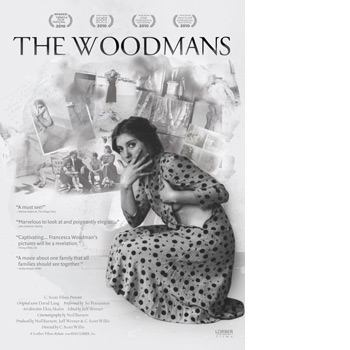
THE WOODSMANS: Provocative Portrait of Photographer Francesca Woodman and Her Artist Family
Documentary Had U.S. Theatrical Premiere Wednesday, January 19 at Film Forum
Francesca Woodman's haunting B&W images, many of them nude self-portraits, now reside in the pantheon of great photography from the late 20th century. The daughter of artists Betty and Charles Woodman (she a ceramicist and he a painter/ photographer), Francesca was a precocious RISD graduate, who came to New York with the intention of setting the art world on fire. But in 1981, as a despondent 22-year-old, she committed suicide.
THE WOODMANS beautifully interweaves the young artist's work (including experimental videos and diary passages) with interviews with the parents who have nurtured her professional reputation these past 30 years, while continuing to make art of their own in the face of tragedy. The film grapples with such issues as parent-child competition and the toxic level of ambition that fuels the New York art scene. It also has much to say about the healing powers of creativity. Winner of the Best New York Documentary award at the 2010 Tribeca Film Festival. —Karen Cooper, Film Forum
It's one of the fundamental questions of art. Who is a work of art ultimately about, the artist or the audience? In film we have the auteur theory, which argues that a movie is the creation of a single author, and that to understand that author is to better understand that movie. Our interpretation of Alfred Hitchcock's filmography and its recurring theme of wrongful imprisonment is enhanced by our knowledge of a story from Hitchcock's childhood; his father had him locked up in a local jail for a couple hours to teach him a lesson. Hitchcock was scarred for life, but that scar produced some wonderful movies. So that brings in a second fundamental question: are the best artists the ones who are the most emotionally damaged? Both of these questions are at the core the new documentary "The Woodmans," a thought-provoking look at one troubled family of artists and their need to express themselves. Francesca Woodman committed suicide at the age of 22 after producing some of the most fascinating photographs of the 20th century. Was her work a cry for help or simply a darkly beautiful point of view of the world? Did her need to compete with her parents, both artists themselves, compel her need to create? "The Woodmans" by director C. Scott Willis offers no simple answers to these questions. It isn't interested in absolving or indicting this family, but rather uses them as a case study to try to understand what makes an artist an artist. Husband and wife George and Betty Woodman have been married for 54 years. George is an abstract painter, Betty a potter. They had two children: Charles, who grew up to become an experimental electronic artist, and Francesca, a photographer. Francesca, arguably the most talented member of the family and inarguably the most emotionally troubled, killed herself in 1981. "The Woodmans" is filled with Francesca's photographs, which are moody and surreal images of nude women, many of whom were portrayed by Francesca herself. Betty believes her daughter's work was not autobiographical, but "The Woodmans" uses Francesca's photographs as the visual accompaniment to the story of her life up to and including George's recounting of his daughter final, tortured months, and they do not seem out of place in that context. But perhaps that's my interpretation, and not Francesca's intent. When Charles and Francesca were young, the Woodmans consumed art the way most families consume food: creating and studying it was absolutely essential to their existence. We imagine children's lives enriched by early exposure to culture. But maybe this particular family's zeal for art pushed past love into something closer to obsession. When the Woodmans would go to a museum, George says, Charles and Francesca would be given a notebook and a time and place to meet so he and Betty could enjoy the art "without the children around our necks." Director C. Scott Willis cuts between George and Betty's interviews and footage of the pair working on their art, juxtaposing their babies with their "babies." We see how incompatible an artist's life can be with a parent's life: the artist must be devoted entirely to one's self and one's impulses, which can leave little time or room for loved ones. Am I suggesting George and Betty neglected their daughter and are therefore responsible for her death? Absolutely not. But George and Betty have clearly wrestled with guilt over Francesca's suicide; in their darker hours, they may still wrestle with it ("Maybe I've been an absolutely horrible mother. I can't go back and rewrite it," Betty says at one point). Throughout the process Francesca herself remains something of a mystery, but that's appropriate given the fact that "The Woodmans" is about her family and friends reflecting back on her life and her work and trying to make sense of her decisions. Francesca's words, taken from her journals, leave nearly as large -- and nearly as ambiguous -- an impression as her photographs ("I am so vain and I am so masochistic. How can they coexist?"). Perhaps the most moving part of "The Woodmans" is George and Betty's creative reaction to Francesca's death. Both changed dramatically as artists -- maybe even improved as artists -- in the wake of the tragedy: George took up photography after years of abstract paintwork while Betty abandoned functional pottery for more whimsical creations. Now she has an enormous mixed media piece hanging in the new American embassy in China. Betty says the most common reaction she gets to her work these days is joy; when people talk about her art with her they say it makes them feel "better." The Woodmans may not believe in autobiographical impulses in artists' work. But that doesn't mean I can't see them in theirs.
Matt Singer IFC
Subscribe to:
Posts (Atom)